The number of popular science staff, popular science venues and popular science funds have remained increased, and the "Report on the Scientific Communication and Development Index of the Provincial (Municipal) in 2020"
Author:Report Time:2022.09.06

pixbay.com
The Shanghai Science Popularization Education Promotion Center released the fifth issue of the "Report on the Scientific Communication and Development Index of the Provincial (Municipal) of the National (Municipality) of the country". The results of the index evaluation show that Beijing, Shanghai and Tianjin have maintained the top three locations in the country, consistent with last year. Compared with the development of science popularization in Jilin Province and Tibet Autonomous Region, the index ranking has increased by 12 rankings and 10 names respectively. If the data of various regional ministries and commissions are excluded, the top 5 regions of the index are Shanghai, Beijing, Tianjin, Guangdong and Jilin Province.
Science Communication Development Index is the first index tool in China to measure regional science popularization development. It was first released in 2018. Based on the national science science statistics of the China Institute of Science and Technology Information, this report is based on the method of quantitative calculation and analysis of mathematical modeling methods. Scientific communication development level. The scientific communication development index involves 31 provinces, autonomous regions, and municipalities in the country, excluding the Hong Kong Special Administrative Region, Macau Special Administrative Region and Taiwan.
Comparison of the ranking index of scientific communication index 2019-2020 (except Hong Kong, Macao and Taiwan)
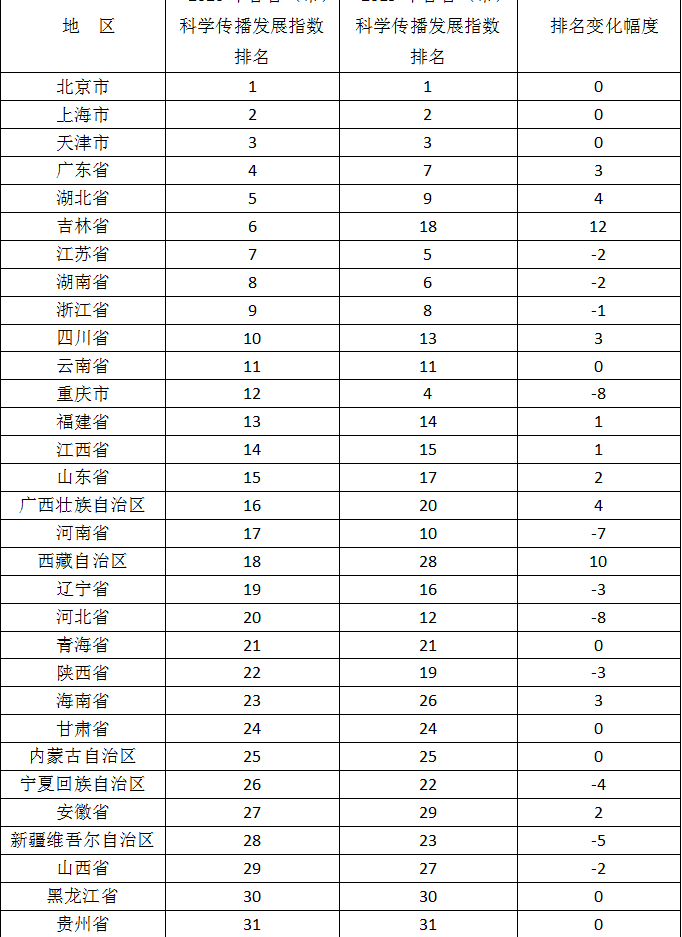
The results of the index analysis in this issue mainly present the following characteristics:
1. In 2020, the proportion of high -quality popular science personnel in the country is generally growing. Among the popular science staff and part -time personnel of science popularization, high -education science popularization personnel accounted for 1.84%in 2019. High -educated science -part -time personnel accounted for 0.92%in 2019. This result reflects the quality of the popular science talent team in various provinces (cities).
2. The total investment in science popularization in the country has continued to increase. In 2020, the national popular science venues and popular science funds remained rising. The number of science and technology museums across the country rose by 7.5%, the construction area rose by 8.9%, and the exhibition area rose 7.2%, which were growing for four consecutive years. The national science popularization fund raising amount was 17.17 billion yuan, an increase of 7%from 2017, and the use of popular science funds in the country was 17.19 billion yuan, an increase of 6.5%from 2017. The reason for the rare amount less than the use amount is that some units have used the balance of the past year in the follow -up science popularization, which causes this situation. It can be seen that my country ’s investment in popular science propaganda has always been growing.
3. The results of national science popularization activities have increased significantly. In 2020, due to the epidemic reasons, many popular science lectures and science popularization exhibitions could not be carried out offline, and they started online. In view of this, the number of popular popularization activities this year has surged. In 2020, the number of nine popular popularization activities in 2020 was 2.73 billion, an increase of 138.3%from 2019. With the help of online science popularization media platforms, the audience of popular science activities has increased significantly, and the results of popular science activities have been greatly improved. In 2020, due to the epidemic reasons, many popular science lectures and science popularization exhibitions could not be carried out offline, and they started online. In view of this, the number of popular popularization activities this year has surged. In 2020, the number of nine popular popularization activities in 2020 was 2.73 billion, an increase of 138.3%from 2019. With the help of online science popularization media platforms, the audience of popular science activities has increased significantly, and the results of popular science activities have been greatly improved.
Some problems were found through the results of the index analysis in this issue, such as:
1. The degree of development of scientific communication across the country is unbalanced.
According to the relevant interpretation of the National Bureau of Statistics, through the relevant policies, my country can be divided into four regions: eastern, central, west and northeast. The eastern region includes 10 provinces (cities) in Beijing, Tianjin, Hebei, Shanghai, Jiangsu, Zhejiang, Fujian, Shandong, Guangdong, and Hainan; the central region includes 6 provinces in Shanxi, Anhui, Jiangxi, Henan, Hubei, and Hunan; Guangxi, Chongqing, Sichuan, Guizhou, Yunnan, Tibet, Shaanxi, Gansu, Qinghai, Ningxia and Xinjiang 12 provinces (autonomous regions, municipalities); Northeast China includes Liaoning, Jilin and Heilongjiang.
In 2020, the popular science index of provinces (cities) nationwide in the country is high in the east, low in the central and western regions. The sum of the popular science index value of 10 provinces (cities) in the east is 2012.27, and the average index value of the remaining seven provinces is 64.46. The value of science indexes in the three provinces in the northeast is 167.88, and the average index of the three provinces is 55.96. The sum of the 6 provinces (cities) science indexes in the central region is 339.49, and the average index value of the six provinces is 56.58. The sum of the science index value of 12 provinces (cities) in the west is 580.35, and the average index value of other eleven provinces outside Chongqing's municipality is 46.77.
In addition, through the display of scattered dots, it can be found that GDP and popular science index values in various provinces across the country have obvious correlations.
2. Rural popular science support strength still needs to be improved. According to data from the National Bureau of Statistics, 902.2 million people in China's urban residence in 2020, 50.992 million rural hukou, 36.1%of rural hukou. Compared with this, the proportion of rural popular science personnel among the national popular science personnel accounted for only 28.03%. On the other hand, there are 196,922 rural science popularization venues, 49812 urban popular science activity rooms, and 79.02%of rural areas. Rural science popularization venues show the situation of "more people and fewer people". In addition, in 2020, the number of international exchanges between Beijing and Shanghai accounted for 96%, showing that international exchanges were mainly concentrated in big cities. 3. Traditional popular science communication is significantly impacted by new media. Generally speaking, from 2017 to 2020, the science popularization venues in cities and rural areas have decreased, and popular science propaganda vehicles and science galleries have also decreased year by year. The number of visitors to professional popular science venues such as science and technology museums and museums shows a rise, which fully reflects that the offline public is willing to go to professional science venues to visit. Similar to the popular science venue, the relevant data of traditional popular science media from 2017-2020 showed a decline in the overall situation. Except for science and technology science science journals, books, discs, recording videos, and science and technology newspapers have been declining. New media communication methods such as TV science popularization, radio science science, and online science science columns have risen in explosive, up 79.1%from 2017 in 2020. In addition, with the science popularization activities of various popular science venues, in addition to the on -site form, it is gradually increasing the new online media platform, which is also one of the performances of traditional popular science media.
Therefore, the research team put forward the following two suggestions:
1. The professionalization of popular science propaganda content and diversification of popular science propaganda forms. On the one hand, popular science propaganda can be classified by refining their own popular science content to tap more popular science propaganda content. On the other hand, popular science propaganda can face different groups of people, targeted adjustment of popular science propaganda content, and can determine the composition of the audience by adjusting the communication channels. In addition, popular science propaganda can conduct science popularization promotion on many melancholy media platforms such as Weibo, WeChat, and Douyin through various methods such as articles, comics, music, and short dramas.
2. Combining the popular science communication methods of new media to increase support for new media. In terms of popular science propaganda, the new media has the advantages of wide communication scope, rich content, novel forms, and strong interaction, which meet the needs of popular science propaganda in all aspects. In addition, the new media is closely related to the development of science and technology. It is still continuously developing and progressing, with huge potential. Therefore, relevant departments of all provinces (cities) governments can use the differences in the direction of new media, in -depth research between the differences between new media and traditional media, and focusing on the role of various channels in the process of popular science communication. Create an excellent and high -quality new media science popularization brand project.
Author: Shen Yisha
Editor in charge: Ren Quan
- END -
State Grid Gaomi City Power Supply Company: Group Studies and Groups to improve the economic operation rate of Taiwan areas
As of now, the economic operation rate of the Taiwan area of the Jinggou Power...
Harbin Bin County promotes the high -quality development of the beef beef industry
Recently, a unique rural ecological freezer beef tasting meeting was held at the Binxi Zhang Mavericks Family Farm in Binxi, Binxian County, Harbin, Heilongjiang Province. The national expert group of