Falling 1.02!The euro has hit a new low for nearly 20 years. It will set off a wave of shortness. Will it be touched next month?
Author:Daily Economic News Time:2022.07.07
On July 7, the exchange rate of the euro against the US dollar fell below $ 1.02, hitting a new low in the past 20 years, and closer to the US dollar at a price.
Due to the increasingly tense supply of natural gas in Europe, the market is concerned about the economic recession of the euro zone, and traders are increasingly believed that the euro against the US dollar below the price will only be a matter of time. According to Bloomberg's option pricing model, the euro's implicit probability of touching parity next month is about 50%. At present, short euro has become one of the most popular transactions.
At the same time, due to factors such as Russia's natural gas supply, the risk of European economic decline is also increasing. The prospect of economic slowdown also allows the market to doubt whether the European Central Bank has the ability to fully tighten the monetary policy to curb the inflation of the record.
Slowing euro is very popular
"Daily Economic News" reporter noticed that in the past few months, the European Central Bank hopes to curb inflation through interest rate hikes on the one hand, and on the other hand, they are worried that interest rate hikes will cause some southern European countries to increase debt pressure. The tightening pace of the central bank lags behind the Federal Reserve and continues the euro. Right now, the risk of energy crisis and Russia's "ventilation" risks have enhanced a shadow of the euro zone economy, and at the same time further enhanced the adventure attraction of the US dollar.
In this context, short euros have become one of the most popular transactions. According to Bloomberg, the strategist of Nomura International and HSBC told customers that it is expected that the euro's bulls will have more losses in the future. According to Bloomberg's option pricing model, the euro's implicit probability of touching parity next month is about 50%.
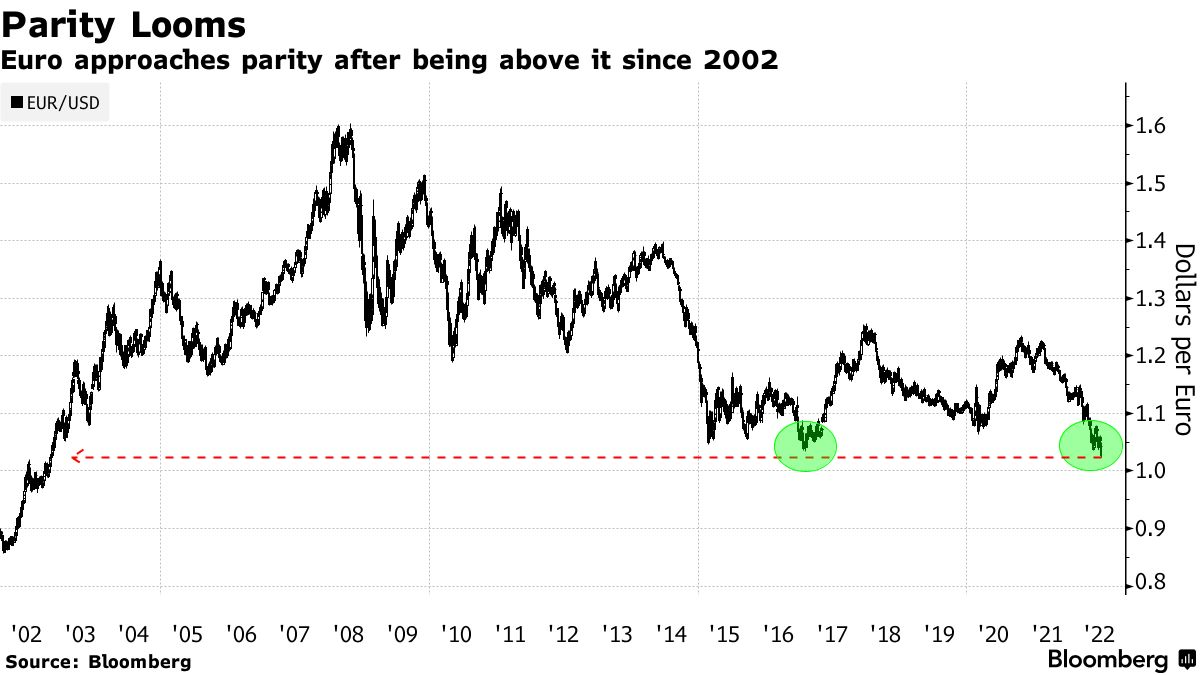
Picture source: Bloomberg
Kaspar Heense, a senior investment portist manager of Bluebay Asset Management, said that cutting off Russia's supply may lead to European distribution system. If this happens, "we will see a serious decline in Europe. This may be a very long winter."
Heense said that Lanwan Assets has been shorting the euro since last month. He predicts that if Russia stops supply, the euro will fall to 1 euro against 90 cents.
Nomura international strategist Jordan Rochester predicts on Tuesday that the euro may fall to 0.98 before August; the Dutch International Group believes that in the worst case, the euro will fall to 0.9545 in the next weeks.
Vasileios Gkionakis, the European foreign exchange strategy director of Citi Group in London, believes that the euro has almost become an almost "non -trading" currency at the moment, especially when the European Central Bank does not have a clear plan for how to cope with inflation and the depreciation of the euro.
Vasileios GKIONAKIS said, "I am very concerned about the speeches of European Central Bank officials in the past few days. These speeches show that there are many concerns and differences within the European Central Bank Management Committee. Either raise interest rates, or you need to come up with an effective mechanism. "
Kit Juckes, chief global currency strategist in France, believes that European energy dependence on Russia is declining, but if some pipelines are closed, this will still lead to a decline in European economy. If this happens, the exchange rate of the euro against the US dollar may fall by about 10%.
Lee Hardman, a exchange rate analyst at Mitsubishi Daily Financial Group, said in a commentary email sent to the reporter of "Daily Economic News", "The impact of strong dollars in recent days is wide. Both the euro have been severely damaged, down 2.5%, 1.8%, and 1.7%, respectively. In contrast, the performance of only the yen in the same period is relatively mild, which also reflects that the concerns of further slowing or decline in the global economy have increased. The exchange rate trend is becoming more and more driven by the demand for risk aversion. "
Hardman also added that two very remarkable empty signals have recently appeared in the global economy: the first is the Bloomberg's commodity index that has almost fallen to the bear market area; followed by the Bloomberg commodity index is now below the 200 -day average, for the reason for it, for the reason For the first time since 2020.
Damo: It is expected that the euro zone will fall into a gentle decline in the fourth quarter
Aside from the factors of short, with the recent surge in natural gas and the continuity of the Russian and Ukraine conflict, the outside world's concerns about the economic recession in the euro zone have intensified. The European Central Bank plans to raise interest rates at the monetary policy conference in late July, which will be the first time that the bank has raised interest rates since 2011.
According to data released by the European Union Statistics last Friday (July 1), the annual inflation rate of the 19th countries in the euro zone in 19 countries reached 8.6%, exceeding 8.1%in May, a new high of inflation rates in the euro zone since 1997. Among them, the energy price of the euro zone has soared 41.9%year -on -year.
On July 5th, the European District Investor Confidence Index announced by the economic research institution SENTIX accidentally fell sharply to -26.4 points, a new low since May 2020. Sentix wrote in social media, "June is just the calm before the storm."
Earlier, the European Central Bank governor Lagarde also said that the current economic activities of the euro zone are facing many unfavorable factors, including high energy costs, deterioration of trade conditions, and high inflationary income of residents' disposable income, so uncertainty is also greater.
A report released by Morgan Stanley last week states that the bank is expected to fall into a gentle decline in the fourth quarter of this year. Economist at the bank said that the reason for the decline in the euro zone's economy includes the decrease in Russia's natural gas transmitted to Europe, the decline in consumer and corporate confidence indicators, and the continued high inflation. On July 4, local time, the British Economic and Commercial Research Center issued a report saying that the risk of economic recession in Europe has increased significantly due to the decline in Russia's natural gas supply, the probability of 40%of the decline in European economy this winter.
The report pointed out that although European countries have different dependence on Russia's natural gas supply, if the shortage of natural gas supply continues to deteriorate, "serious economic recession is almost inevitable." This will not only be limited to Germany, Italy and other countries that rely on Russia's natural gas supply. The fluctuations in the world's natural gas prices and insufficient natural gas gas storage capacity will also make Britain and other European countries impact. Some European companies may be closed because of this, and given that European countries are highly related to the industrial supply chain, they may further intensify the risk of European economic recession. In addition, energy shortage has led to further growth in the European consumer price index and increased inflation pressure, which will also lead to further deterioration of the European economic situation.
However, some investment banks believe that the reason for the continuous weakening of the euro may be more than just the shortage of natural gas.
In a report released by German Bank on Wednesday, the pressure point of the euro is not only in the shortage of natural gas in Germany, but also a broader European energy market. French Power Corporation (EDF) announced on Wednesday morning that it is proven to further reduce power.
George Saravelos, head of Global Foreign Exchange Research, said that as the United States has increased the risk of technological recession, the "risk aversion" trend of the US dollar may become "more extreme" and further increase the downward pressure of the euro against the US dollar transactions. "The conclusions we have come on is that if Europe and the United States have fallen into a decline in the third quarter, and the Federal Reserve is still raising interest rates, the euro exchange rate against the US dollar will fall to 0.95 ~ 0.97." Saravelos wrote.
Daily Economic News
- END -
The "Great Kingdom Grain" to accumulate new kinetic energy in order to create a "international new grain dealer"

In the past, Peking University of Wilderness was a very cold place for the land of...
Tongjiang Port Xiahang Shouhang

On June 12, at the Water Transport Wharf of the West Port in Tongjiang Port, with ...