The whole version of the Times reports reports that the Chinese Academy of Fine Arts Graduation Exhibition: The Eastern Millennium Inspirational Higher Institute of Institute of Inspiration continues to stimulate art "living power"
Author:China Art College Time:2022.08.13
A few days ago, the mainstream British media "The Times" was published "Art for Life's Sake" (reference translation: artistic due to life), reported to the 2022 graduation work exhibition of the Chinese Academy of Fine Arts. The cutting -edge exploration of art and science and technology integration, as well as the innovative practice of art to help urban development.
Earlier, the official Facebook account "The Times and the Sunday Times" of the Times was published by the editor of the article of the article of the article, the theme of the Chinese Academy of Fine Arts's graduation exhibition this year, the theme of the Chinese Academy of Fine Arts Every time. The graduation exhibition encourages students to reflect on the changes in our lives and how the world adapts to the impact of rapid transformation of technology.
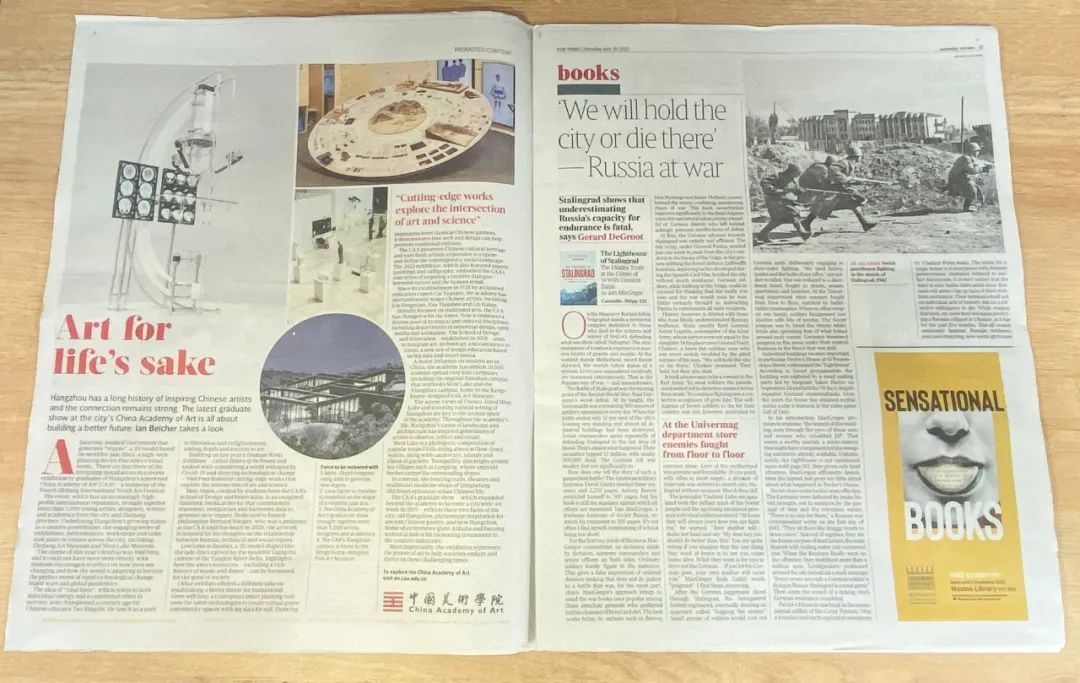
"Times" newspaper layout real shot
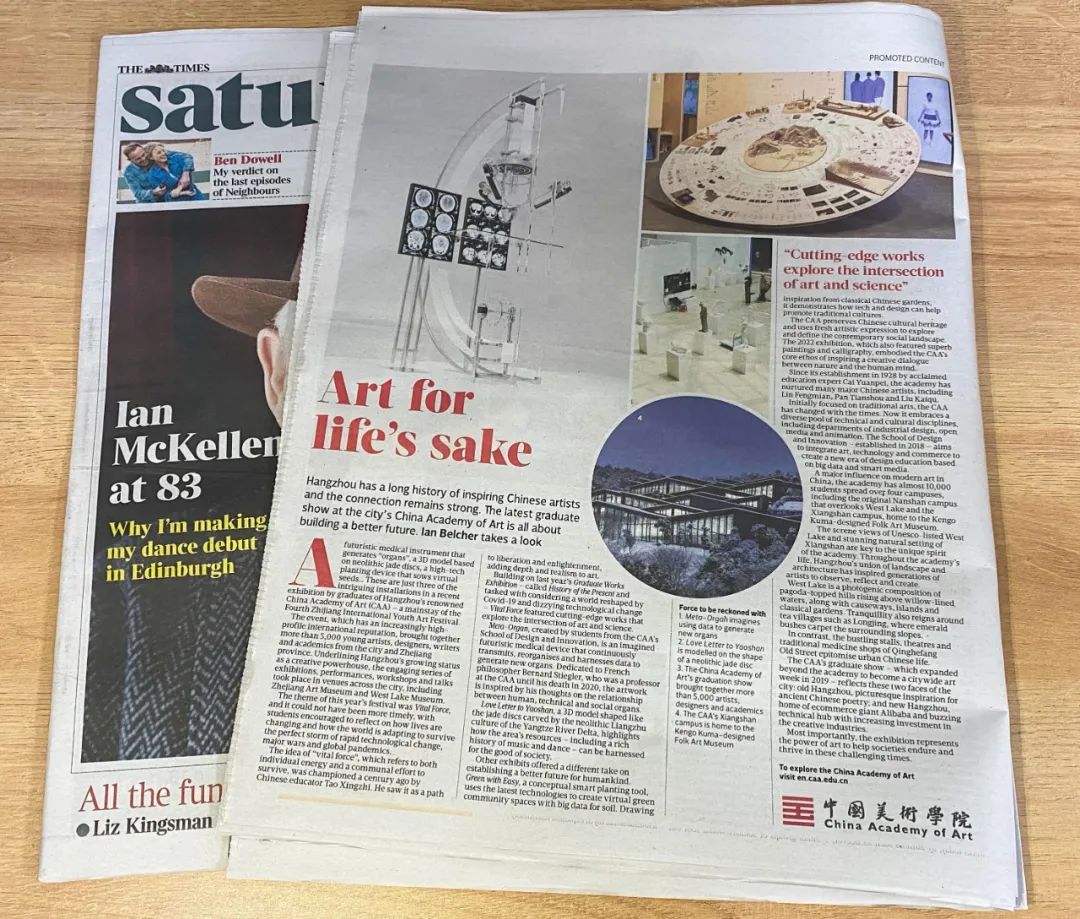
"Times" newspaper layout real shot
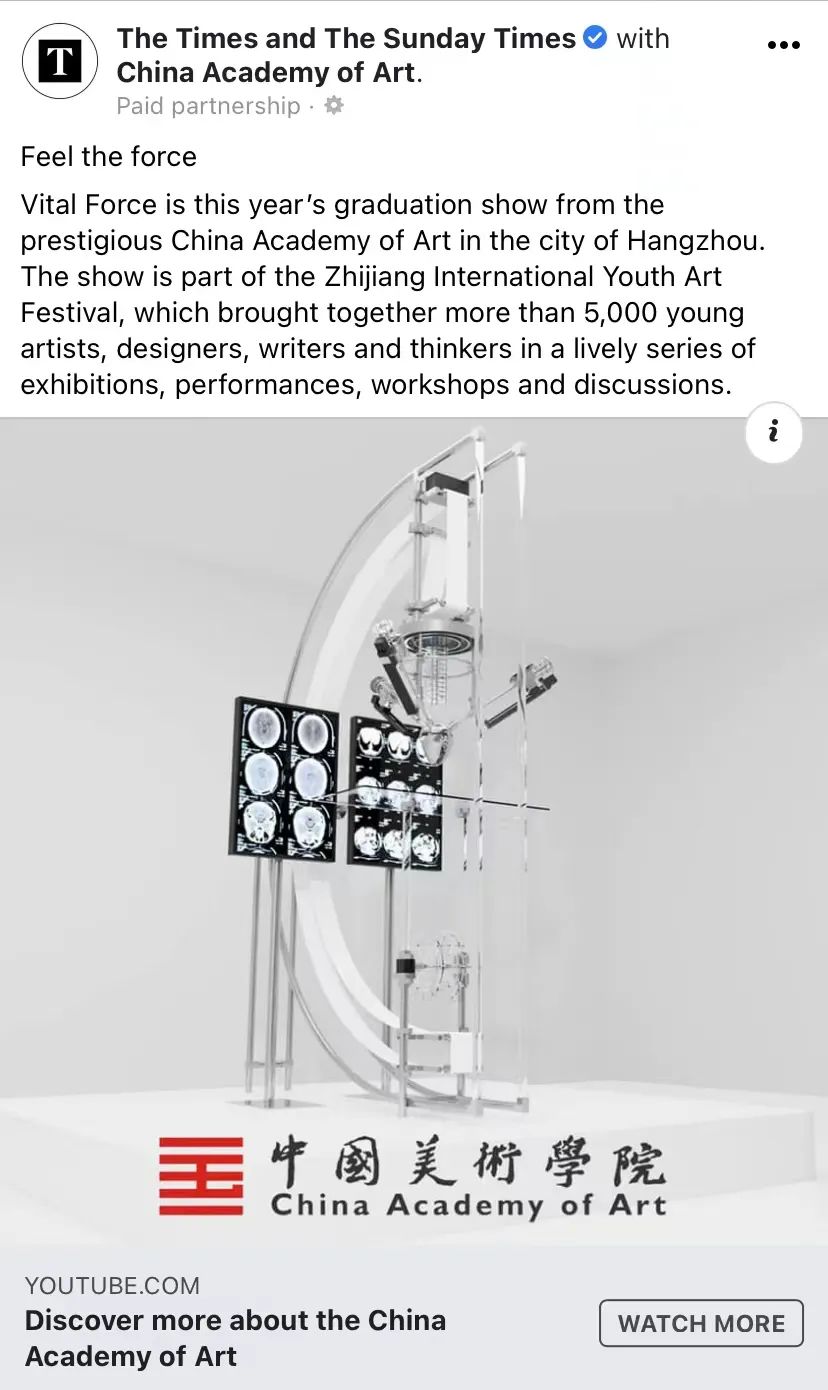
Screenshot of the official Facebook account of the Times
As early as 2019, the Times published an article "Natural Wonder -Hangzhou Living Poetry" (reference translation: exploring natural victory -the most memories of Hangzhou), thinking that Hangzhou is the source of inspiration for the continuous energy of China in China for thousands of years. In the article "Art for Life's Sake", the Times is based on the Chinese Academy of Fine Arts, the Chinese Higher Art Institute in Hangzhou, and mentioned again: " It is a key role. In the development of the Chinese Academy of Fine Arts, the natural combination of Hangzhou landscape and architecture has inspired a generation of generations of artists to continue to observe, reflect and create. "
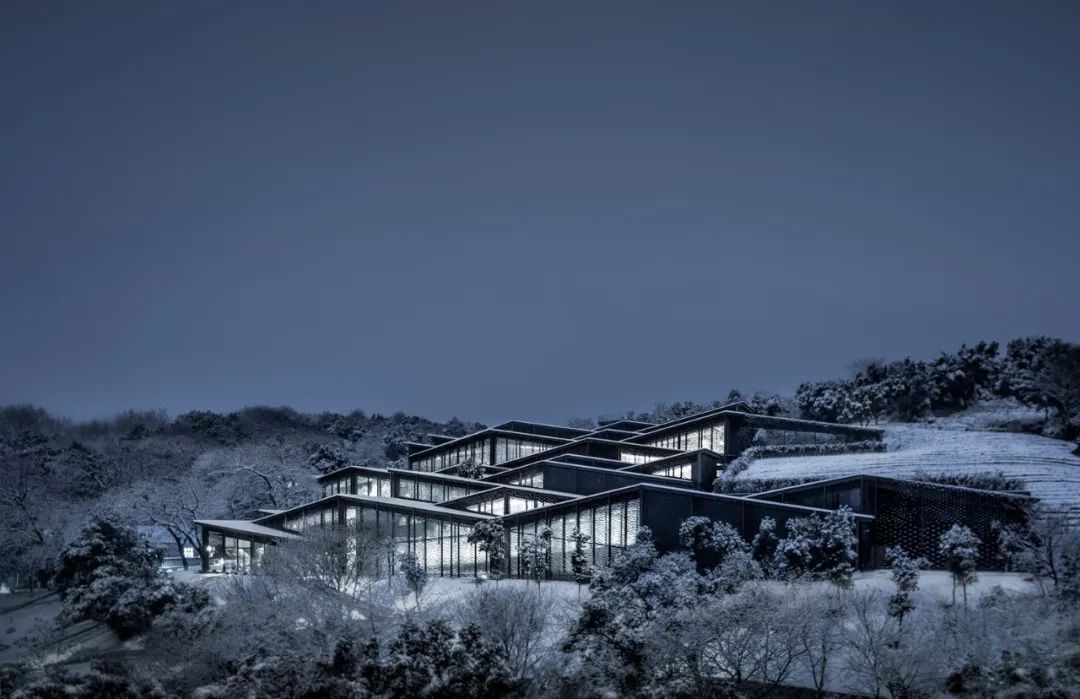
Real view of Xiangshan Campus of China Academy of Fine Arts
The Times pays special attention to the three cutting -edge works of the fusion of art in the graduation exhibition this year, all of which come from the School of Innovation and Design. The work "Later Organ" was created to commemorate the French philosopher Berner Stegler, a French philosopher at the Chinese Academy of Fine Arts before his death in 2020, inspired by his thinking about the relationship between human, technology and social organs; works "Yaoshan Xinyu" highlights the resources of the Liangzhu area, including its rich music and dance history. The garden draws inspiration, showing how technology and design promote the development of traditional culture.
The Times believes that "the Chinese Academy of Fine Arts inherits the Chinese cultural heritage in exhibits, and explores and defines the contemporary social map with novel artistic expression. ","
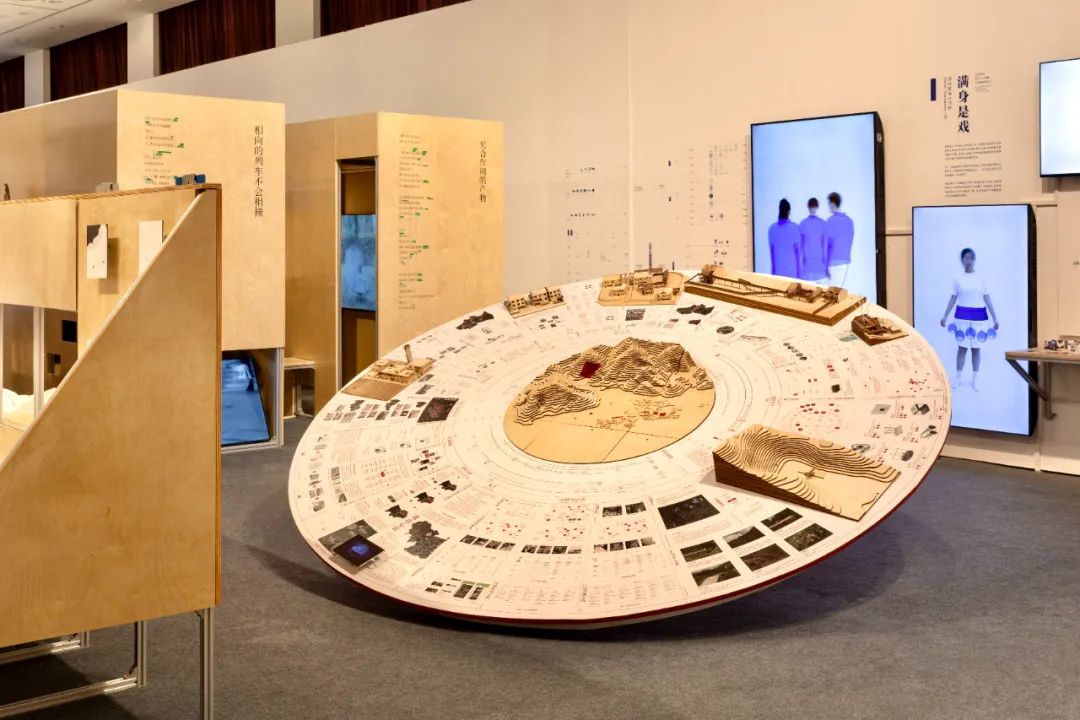
The work of the work "Yaoshan Heart Language" exhibition scene was shot at the scene
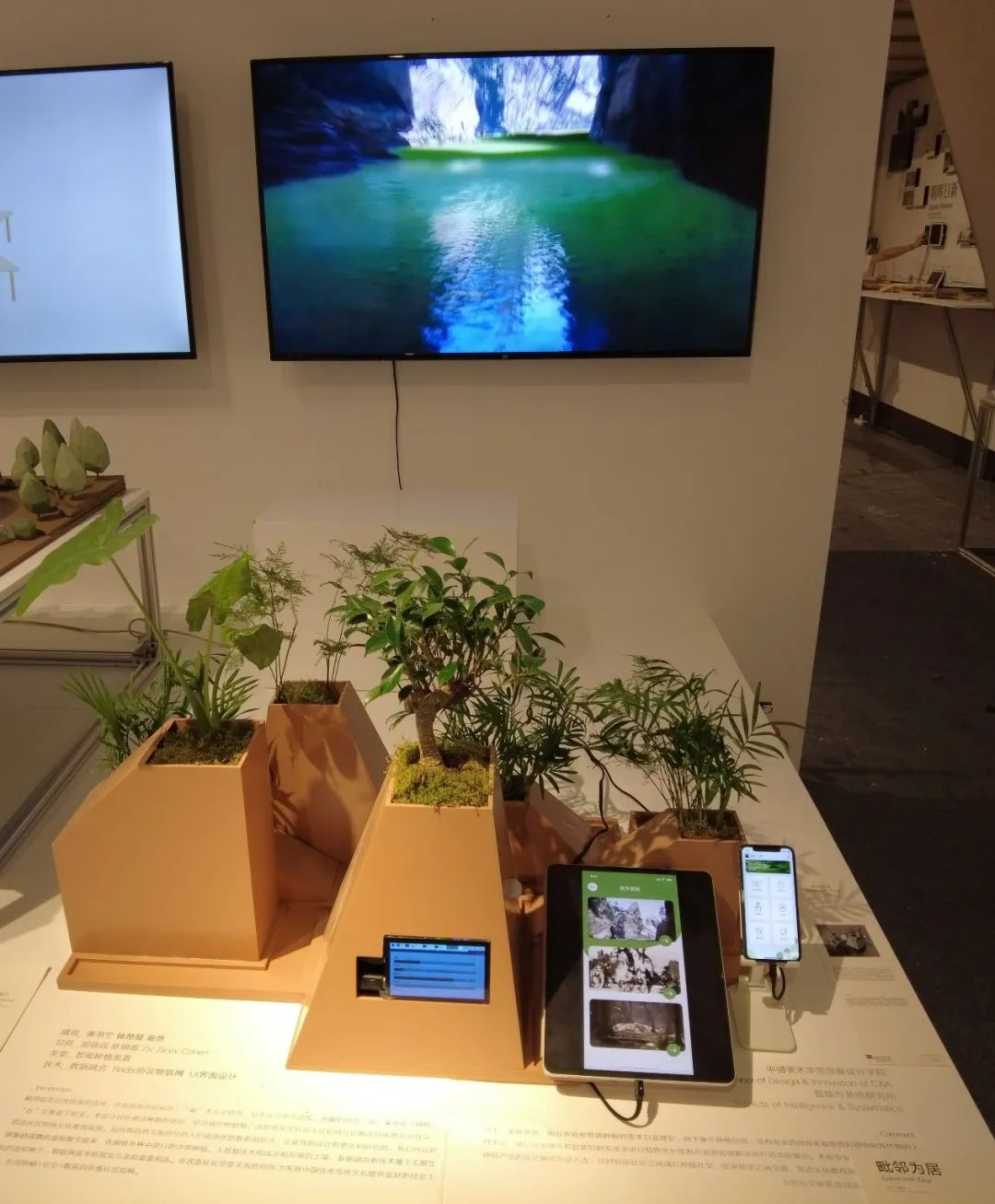
The real shot of the work "Green Yi" exhibition site
Since 2010, the Chinese Academy of Fine Arts has comprehensively demonstrated the results of teaching creation in a new form of "Graduation Show Week" and opened the precedent of the Chinese Academy of Arts; in 2019, the Chinese Academy of Fine Arts once again broke through the "wall" and upgraded the conventional graduation season exhibition to become it. Art week. Every year, the scale and field are continuously upgraded and extended. Now the "graduation season" of the Chinese Academy of Fine Arts has become a city festival in Hangzhou, allowing citizens to enjoy art carnival.
In this regard, the Times commented: "Graduation of the Chinese Academy of Fine Arts shows that art is helping to develop urban development and welcome various challenges."
"The Times" was published in 1785 and was a comprehensive daily newspaper issued by the United Kingdom. It had a huge impact on politics, economy, and culture around the world.
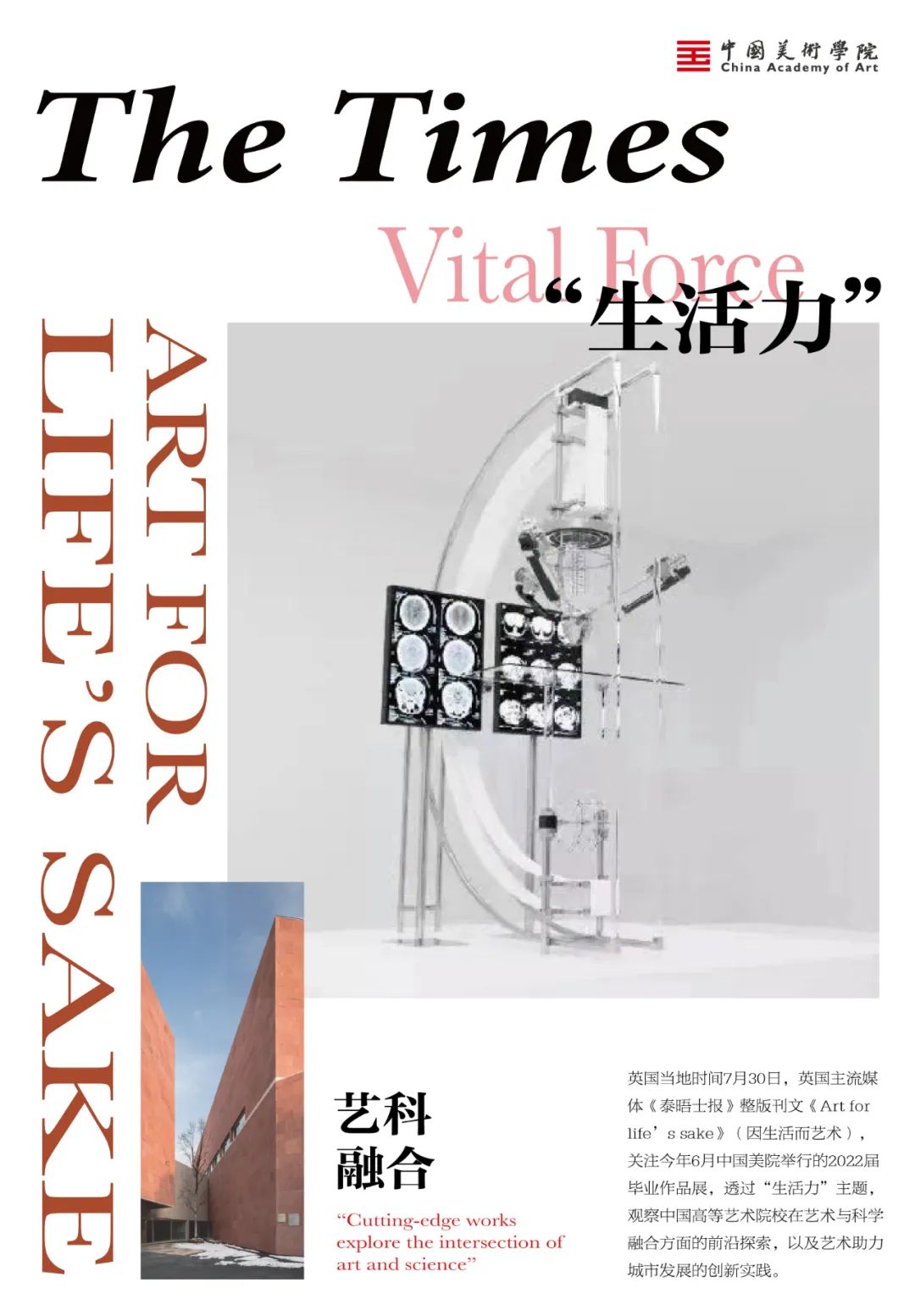
"Times" pays attention to posters of the integrated development achievement of the Chinese Academy of Fine Arts (designed by Liu Chang)
The following is the full text of the "Art for Life’ s Sake "published by the Times and Chinese comparison version:
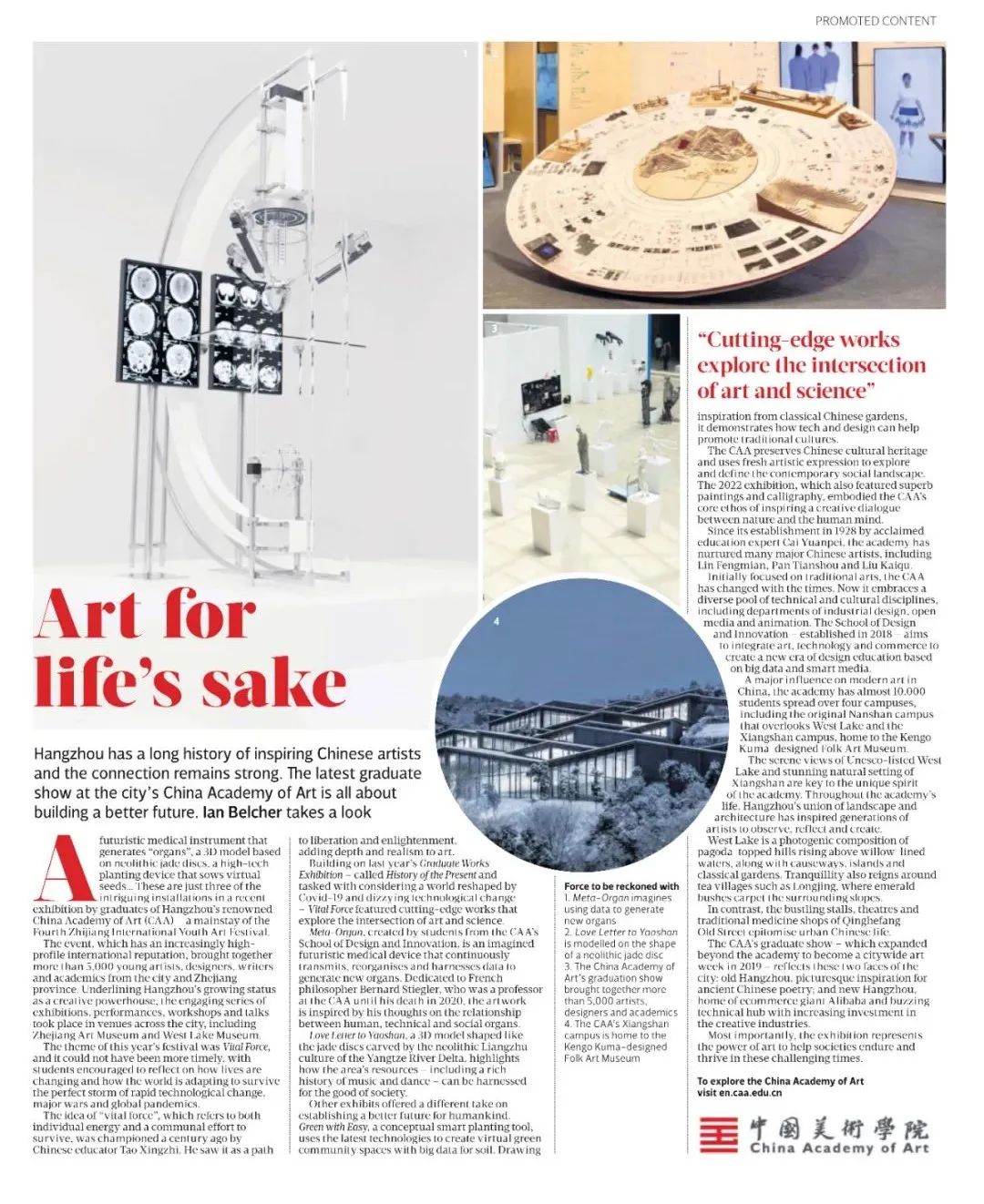
Art for live ’s saK
Art of life
Hangzhou has a long history of inspiring Chinese artists and the connection remains strong. The latest graduate show at the city’s China Academy of Art is all about building a better future. Ian Belcher takes a look.
Hangzhou has a long history of inspiration and inspiration to Chinese artists, and life is closely linked to Hangzhou. In June of this year, the Chinese Academy of Fine Arts held a graduation work exhibition, and its theme focused on building a better future. Ian Bellche takes you to see this work exhibition.
A futuristic medical instrument that generates “organs”, a 3D model based on neolithic jade discs, a high-tech planting device that sows virtual seeds… These are just three of the intriguing installations in a recent exhibition by graduates of Hangzhou's renowned China Academy of Art (CAA) - Mainstay of the Fourth ZHIJIANG International Youth Art Festival. Future medical instruments that produce "organ", 3D models based on the Neolithic jade discs, high -tech planting equipment for sowing virtual seeds ... This is only located in Graduates from the Chinese Academy of Fine Arts in Hangzhou recently displayed three interesting devices. The Chinese Academy of Fine Arts is the organizer of the Fourth Jiangjiang International Youth Art Week.
The event, which has an increasingly high-profile international reputation, brought together more than 5,000 young artists, designers, writers and academics from the city and the surrounding province of Zhejiang. Underlining Hangzhou's growing status as a creative powerhouse, the engaging series of exhibitions , Performances, Workshops and Discussions TOOK PLACE in Venues Across the City, Including Zhejing Art Museum and WEST LAKE MUSEUM.
In recent years, the international reputation of the graduation exhibition of the Chinese Academy of Fine Arts has continued to improve. This exhibition has brought together more than 5,000 young artists, designers, writers and scholars from Hangzhou and other areas in Hangzhou and Zhejiang Province. A series of fascinating exhibitions, performances, and seminars have held a series of fascinating exhibitions, performances, and seminars, highlighting Hangzhou's increasing creative center status.
The theme of this year’s festival was Vital Force, and it could not have been more timely, with students encouraged to reflect on the way our lives are changing and how the world is adapting to survive the perfect storm of rapid technological change.
The theme of this year's art festival is "living power", which coincides with this theme. The graduation exhibition encourages students to reflect on the changes in our lives and how the world adapts to the impact of rapid transformation of technology.
The idea of “vital force”, which refers to both individual energy and a communal effort to survive, was championed a century ago by Chinese educator Tao Xingzhi. He saw it as a path to liberation and enlightenment, adding depth and realism to art.
A century ago, Tao Xingzhi, a Chinese educator, put forward the concept of "living power", which refers to both personal survivability and collective survival efforts. Tao Xingzhi believes that this is a path to liberation and enlightenment, and "living power" adds depth and realism to art.
Building on last year's Graduate Works Exhibition – called History of the Present and tasked with considering a world reshaped by Covid-19 and dizzying technological change – Vital Force featured several cutting-edge works that explore the intersection between art and science.“生活力” The concept is based on the theme of last year's art festival, "Now History". The task of "now history" is to think about the world of new crown virus reshaping and dazzling technical changes. The theme exhibition of this "living force" exhibited several cutting -edge works to explore the fusion of art.
Meta-Organ, created by students from the CAA's School of Design and Innovation, is an imagined futuristic medical device that continuously transmits, reorganises and harnesses data to generate new organs. Dedicated to French philosopher Bernard Stiegler, who was a professor at the CAA until His deth in 2020, the artwork is inspired by his thoughts on the relatedship between human, the technology and social organs.
"Later Organ" is a work of graduates of the Innovation and Design Institute of China Academy of Fine Arts. This is an imaginary future medical equipment. It can continuously transmit, reorganize, and use data to generate new organs. At the same time, the work was created to commemorate the French philosopher Berner Stegler, who had been a professor at the Chinese Academy of Fine Arts before his death in 2020, inspired by his thinking about the relationship between human, technology and social organs.
Love Letter to Yaoshan, a 3D model shaped like the jade discs that were carved by the neolithic Liangzhu culture of the Yangtze River Delta, highlights how the area's resources – including a rich history of music and dance – can be harnessed for the good of society Then, then, then
"Yaoshan Heart Language" is a 3D model, shaped like the Jade Plate of Liangzhu Cultural Culture in the Neolithic Shili Times of the Yangtze River Delta. Use to benefit the society.
Other exhibits offered a different take on establishing a better future for humankind. Green with Easy, a conceptual smart planting tool, uses the latest technologies to create virtual green community spaces with big data for soil. Drawing inspiration from classical Chinese gardens, it demonstrates how Tech and Design Can Help Promote Tradingal Cultures.
How to create a better future for humans, other exhibits provide different perspectives. "Green" is a conceptual intelligent planting tool. It uses the latest technology to create virtual green community space through big data related to the soil. This work draws inspiration from Chinese classical gardens, showing how technology and design promote the development of traditional culture.
The CAA preserves Chinese cultural heritage and uses fresh artistic expression to explore and define the contemporary social landscape. The 2022 exhibition, which also featured superb paintings and calligraphy, embodied the CAA's core ethos of inspiring a creative dialogue between nature and the human mind.中国The Academy of Fine Arts inherit Chinese cultural heritage in exhibits, and explores and define the contemporary social map in the form of novel artistic expression. The Chinese Academy of Fine Arts also exhibited superb painting and calligraphy works in 2022. The entire exhibition demonstrated the core concept of the Chinese Academy of Fine Arts, that is, inspiring the creative dialogue between nature and human soul.
SINCE ITS ESTABLISHMENT in 1928 by Acaclaimed EXPERT CAINPEI, The Academy Has Nurtured MAJOR Chinese Artists, Including Lin Fangmian, Pan Tianshou and Liu Kaique.
Since the founding of the famous educator Mr. Cai Yuanpei in 1928, the Chinese Academy of Fine Arts has trained many Chinese arts including Lin Fengmian, Pan Tianshou and Liu Kaiqu.
Initially focused on traditional arts, the CAA has changed with the times. Now it embraces a diverse pool of technical and cultural disciplines, including departments of industrial design, open media and animation. The School of Design and Innovation – established in 2018 – aims to Integraate Art, Technology and Commerce to Create A New Era of Design Education Based on Big Data and Smart Media.
The Chinese Academy of Fine Arts originally focused on the field of traditional art, but always insisted on keeping pace with the times. Today, the Chinese Academy of Fine Arts has many disciplines, including industrial design, open media and animation. The School of Innovation Design was established in 2018 to integrate art, technology and business, and create a new era of design education based on big data and intelligent media.
A major influence on modern art in China, the academy has almost 10,000 students spread over four campuses, including the original Nanshan campus that overlooks West Lake and the Xiangshan campus, which is home to the Kengo Kuma-designed Folk Art Museum.
The Chinese Academy of Fine Arts has been in the modern art community in China. Nowadays, there are nearly 10,000 students in schools, distributed in four campuses, including Nanshan Campus on the West Lake and Xiangshan Campus.
The serene views of Unesco-listed West Lake and stunning natural setting of Xiangshan are key to the unique spirit of the academy. Throughout the academy's life, Hangzhou's union of landscape and architecture has inspired generations of artists to observe, reflect and create.被列The West Lake in the UNESCO Lake Pingyuan and Xiangshan's far away have played a key role in the cultivation of the spirit of the Chinese Academy of Fine Arts. In the course of the development of the Chinese Academy of Fine Arts, the natural combination of Hangzhou landscape and architecture inspired a generation of generations of artists to continue to observe, reflect and create.
West Lake is a photogenic composition of pagoda-topped hills rising above willow-lined waters, along with causeways, islands and classical gardens. Tranquillity also reigns around tea villages such as Longjing, where emerald bushes carpet the surrounding slopes.
West Lake is a place for tourists. The hills with a pagoda stand on the water surface of the willow tree. The embankment roads, islands and traditional gardens are vaguely visible in the distance. The tea villages such as Longjing Village are quiet and far away, and the emerald green shrubs are covered with the surrounding hillside.
In Contrast, The Bustling Stalls, TheATRES and TraditationAl Medicine Shops of qinghefang Old Street Epitomise Urban Life.
In contrast to it is the bustling stalls, theaters and Chinese herbal medicine shops of Qinghefang Old Street, which are the epitome of Chinese urban life.
The CAA's graduate show – which expanded beyond the academy to become a citywide art week in 2019 – reflects these two faces of the city: old Hangzhou, picturesque inspiration for ancient Chinese poetry; and new Hangzhou, home of ecommerce giant Alibaba and buzzing technical hub With increasing investment in the creative foundries.
In 2019, the graduation exhibition of the Chinese Academy of Fine Arts came out of the campus and became the Hangzhou Art Festival. It reflected the two sides of the city, one side of the old Hangzhou, and the new Hangzhou. The former became the first source of inspiration for ancient Chinese poems, and the latter was the headquarters of the e -commerce giant Alibaba. At the same time, with its booming science and technology center position, it attracted the creative industry investment of all parties.
Most Importantly, The Exhibition Represes the Power of Art to Help Societies endure and Thrive in the Challenging Times.
The graduation work exhibition of the Chinese Academy of Fine Arts shows that art is helping urban development and greeting various challenges.
Source | Times Newspaper Xinhua News Agency
Editor | Jia Yuxiu Xie Jiayi
Responsible editor | Hu Xinyun
Trial of nuclear | Ding Jianfeng
Submit mailbox: [email protected]
Produced:
Propaganda Department of the Party Committee of China Academy of Fine Arts
Publicity Office of the CPC CAA Community
News Center of China Academy of Fine Arts
CAA News Center
CAA Rong Media Studio
CAA Media Convergence Center

- END -
I dare not watch the circle of friends after 05, watch the sour once
There is something that has always made me inferior--Can't ride a bicycle.As a res...
In 1992, Suzhou girl, reconciled the beautiful scene of "Menghua Record"
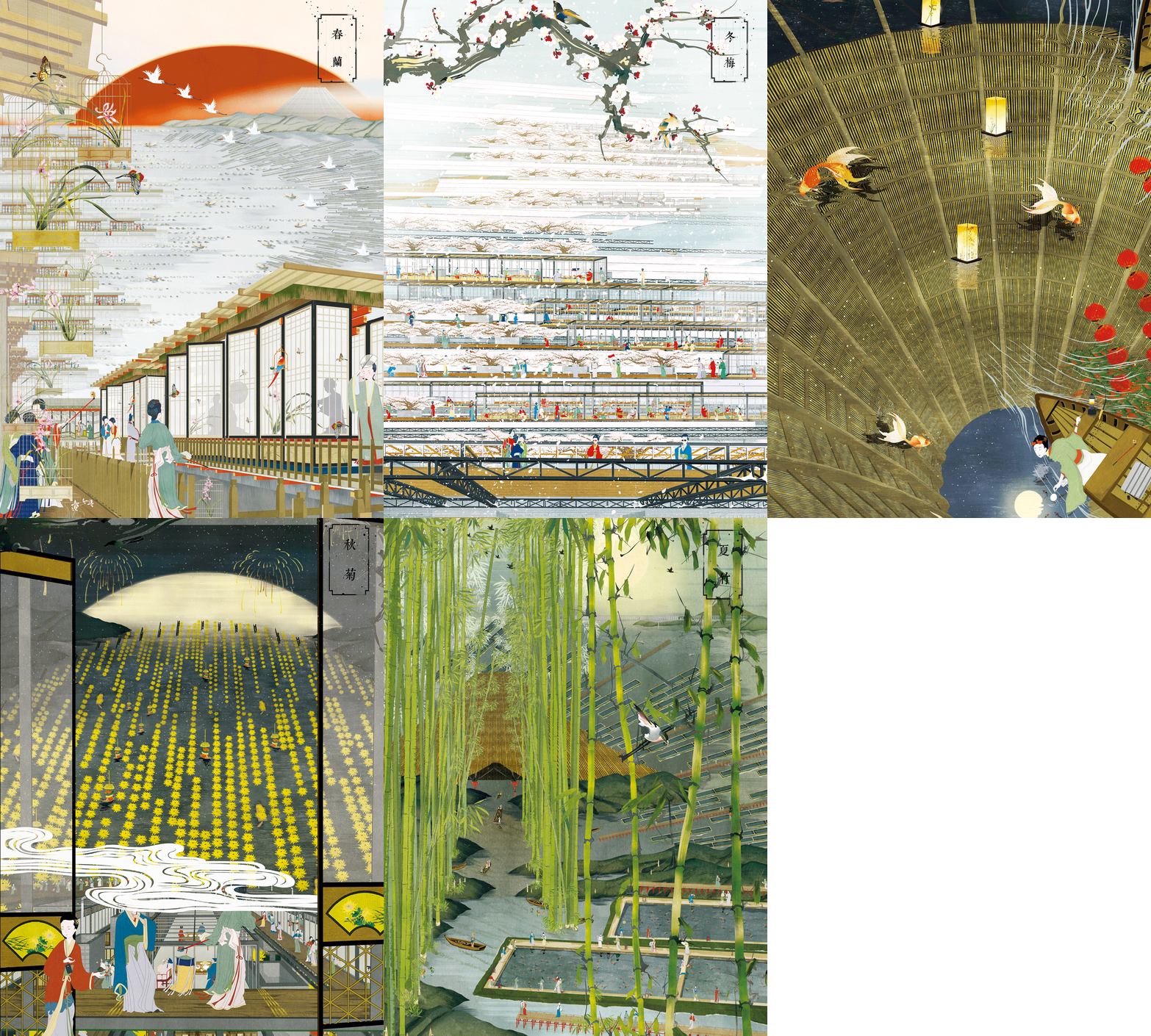
The title of the recent hit drama Menghua Record,Memoirs from the veteran of the S...