Qin Yaqing: In interactive culverts, Chinese knowledge contributions to human common knowledge | Academic China · 2022-2
Author:Report Time:2022.08.27
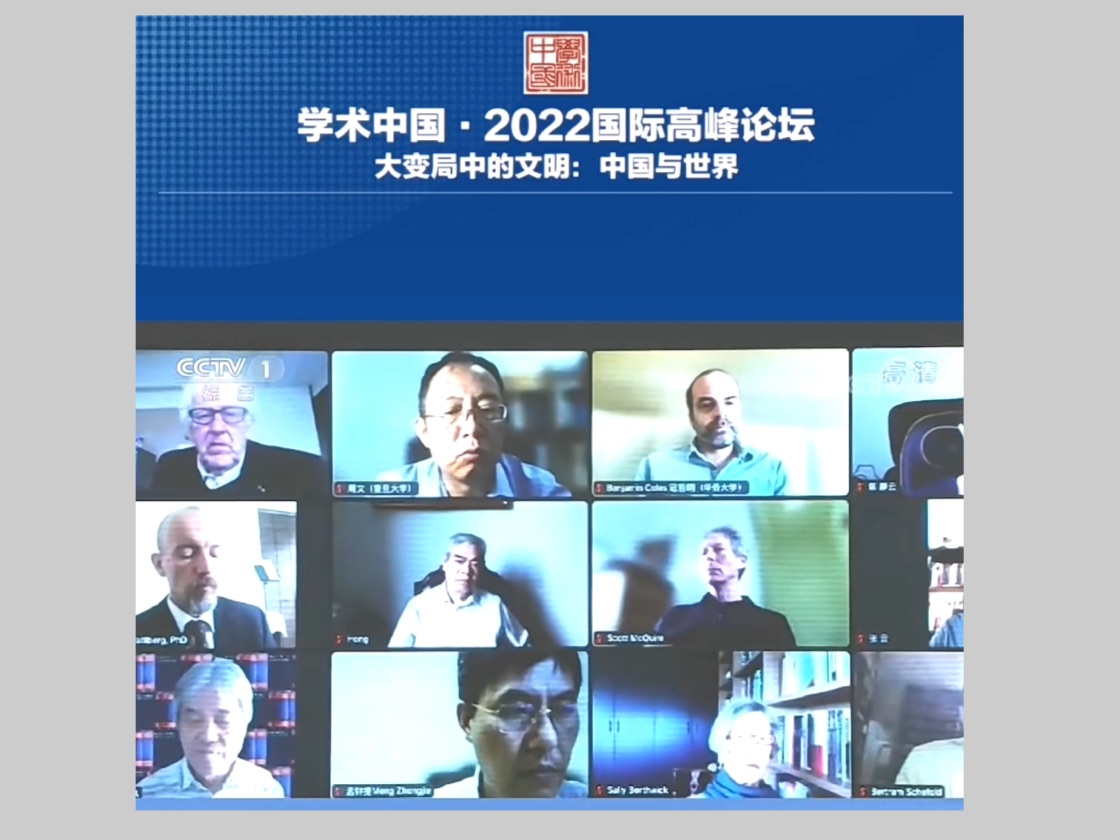
Online overseas well -known overseas scholars who participated in the opening ceremony from the opening ceremony of China Social Sciences News Website
[Introduction] At 9 am yesterday (26th), the "Academic China · 2022" International Summit Forum hosted by the Chinese Academy of Social Sciences kicked off the theme of the "Civilization: China and the World" theme. In a day and a half, 80 top domestic scholars, 30 internationally renowned scholars, and 20 young scholars will reveal the unique contributions and unique contributions of Chinese civilization from multi -disciplinary, multi -dimensional, and multi -level in the opening ceremony and five parallel forums. The value of the times, thinking about the development trend of human civilization, discuss the exchange and learning of Chinese civilization and civilizations from all over the world, and promote the rejuvenation of Chinese civilization and the development of world civilization.
The "Academic China" International Summit Forum is also known as the "Hundred Talents Forum". It makes it an important platform for prospering China's academic, developing Chinese theory, and spreading Chinese thoughts, and becoming a brand of academic forums with important influence in the world.
The first "Academic China" International Summit Forum was held on October 14-15, 2021. Many guests participated in the lecture hall, and the lecture hall was also reported. From today, it has been reported to be a guest view of academic China in 2022 to listen to friends and readers. The first article is Huang Ping, the executive deputy dean of the Hong Kong Academy of Academic Research, "Speaking the theory of things, the narrative logic of building the community of human destiny" (see the link at the end of the article)
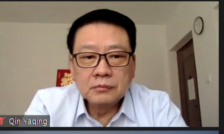
Qin Yaqing (former dean of the School of Foreign Affairs and professor in Shandong University) from online screenshots
During the current period, knowledge production is indeed an important issue for the Chinese intellectual community in China. It can be said that in recent years, China's international relations have entered the academic field of world -world relations. On the one hand, a positive impact has been developed, and on the other hand, it has also triggered fierce debate. The most fundamental debate topic is Chinese issue. The development of China's international relations theory is a process of knowledge cherrying, and knowledge culverts are an important path to common knowledge of human beings. Therefore, I want to talk about three questions in 15 minutes.
Knowledge of knowledge: an important path of knowledge renovation in diversified civilizations
First, what is knowledge? Definition in the simplest way is to refer to the social knowledge reproduction process caused by the interaction between different cultures, absorb the input of foreign studies, do not let go of the original knowledge of the nation, and use these two seemingly different knowledge systems On the contrary, the moderate dialectical method of the mutually integrates. I hope to gradually develop this concept into a theory.
Everyone knows that the world consists of a diversified community of practice, a space for diversified practical knowledge interaction, and practicing community interaction, communication, debate, etc., is an important way for knowledge generation and evolution. The practical knowledge itself is also formed through introverted and extroverted practice, and culture is common practical knowledge. Through such interaction, the two knowledge system interaction and integration of mutual integration to generate new knowledge; after the emergence of the new knowledge system, it is also necessary to use more deeply to distinguish between each other and reflect on evolution. In the end, It is part of the common knowledge of human beings in a diverse form.
Therefore, knowledge culverts point to an important path of social knowledge in the world's context of a diverse civilization.
Single, two -way, interaction culverts: Combining common knowledge from culture and his culture
Second, the stage and characteristics of knowledge. Hanyu is a process that does not happen overnight. It is a process of knowledge exchange and blending of different cultural communities to produce new knowledge. The premise of this process is the common and communication of multiple intellectual forms, which is characterized by open and inclusive. It can be divided into three stages -one -way culverts, two -way culverts, and interaction, but each other is not so completely, and sometimes overlap at each other.
One -way culverts mainly refer to the knowledge system of the knowledge of a cultural body and affecting another cultural body. In other words, it is more of an influence of one -way knowledge, which is characterized by knowledge learning. For example, Buddhism entered China in the early days and began to influence Chinese intellectuals and society, and finally developed into Zen; Chinese culture was introduced into Central Asia, other ethnic groups, other ethnic groups, other ethnic groups, other ethnic groups, other ethnic groups, other ethnic groups Or modern Western culture and knowledge entered East Asia, all of which are such processes. The form of expression is often disseminated. The early US international relations knowledge was mainly learned from Europe, and the knowledge of international relations before the behaviorist revolution was mainly to learn traditional European international relations theory, diplomatic theory, and history. This is one -way. After the efforts of scholars by scholars, they will develop towards two -way chanchization.
The two -way culvert is the one -way cherishment of knowledge began to have a reflection effect in the acceptance party. He must play his own dynamic role, perform knowledge reproduction by reflective reconstruction, and produce the cultural elements and significance. For example, Buddhism in China has evolved into Chinese Buddhism, which is such a process. Since the exchanges with culture, we have begun to seek a reproduction of knowledge, which may produce new knowledge products with self -culture. Therefore, the characteristics of the two -way chanization are theoretical innovation. This innovation is original, and if it is not suppressed by the power of knowledge, the two -way effect will begin to have an effect. The two -way culverts dug out the knowledge elements of culture, and form a product -oriented product -oriented product -oriented product -oriented in dialogue with his cultural knowledge, and the social theory is diversified.
Interactive culverts are the cultural core of the culture and his culture from the culture and his culture, forming a mutually integrated relationship. The knowledge of culture and his culture is still different, but it is a difference in complementarity. The integratedness of knowledge is expressed on both sides. The characteristics are the integration of knowledge. In the ideal interaction mode, the diversity of knowledge promotes the prosperity of knowledge production. The debate and dialogue between knowledge have contributed to the sublimation of knowledge. The ultimate purpose is to build a common knowledge of human beings. Human knowledge produced by interaction and culverts is based on the practical knowledge of multiple civilizations. Any local knowledge has knowledge legitimacy, but any sexual knowledge has no knowledge monopoly. Therefore Related, one -way two -way and interactive manifestations are a logical premise. One -way culvert is the prerequisite for bidirectionalization, and the two -way culvert is the prerequisite for interactive culverts.
At present, the fields of international relations and world international relations are in the early stages of two -way culverts. Western international relations still dominate. The theory of non -Western international relations has sprouted. Western international relations knowledge can be developed.
Will the Chinese nature in Chinese international theory lead to cultural essence?
Third, the development of China's international relations theory and Chinese issue. At present, the development of China's international relations theory is relatively ahead of the non -Western world, has surpassed the single culvert, and initially entered the two -way citizenship stage. The sign is the generation of China's international relations theory. For example, the "world" and "symbiosis" theory, which are often mentioned, etc. The common point of these theoretical innovation is based on the traditional Chinese culture as the basic knowledge and resources, which has a certain impact in the world's international relations community, of course, which has caused fierce debate - - Specifically, Chinese nature has become a major criticism of Western scholars.
Some scholars believe that this shows cultural substantiveism, leads to cultural centralism, and even forms a dual division of international relations. At the stage of entering the two -way culvert, Chinese scholars chose Chinese traditional cultural ideas as the knowledge resources of theoretical construction, laying the foundation for diversification and diversity. Although there are the same and different ideas in different cultures, it is found that differences are an important prerequisite for guiding innovation. Even in a cultural body, there is only one standard for international relations, one kind of life. Therefore, excavation in the tradition of the secondary cultural tradition is not only a mistake, but also a contribution.
If only one culture can be used as a legitimate resource of knowledge, this culture will become a monopoer of knowledge through power operation, and then become the terminator of knowledge; Undested cultural essence, subverting cultural centers, and ultimately eliminating the important path of cultural essence.
So does the use of traditional culture as a knowledge resource for social theory construction will inevitably lead to cultural essence and cultural center theory? My point of view is not, it can guide three results. The first is to adhere to cultural essence or move towards cultural center. Knowledge System. It will better expand social theory to the global category and make it real human significance. When using traditional culture as a construction and knowledge resource, it is necessary to prevent academic nationalism from causing cultural essence and cultural centralism, but also to vigorously tap traditional culture to create it, so that traditional culture can produce innovative development. Become part of the common knowledge of human beings.
Therefore, interaction and culverts, as the production of knowledge, are precisely key practical activities that eliminate cultural centerism and maintain the originality of social knowledge. In the process, a certain emphasis on practical activities and knowledge products that emphasize self -culture, but this kind of thing should be a strategic cultural substantialism, rather than essentialism. Therefore, because of this, China's theory of international relations is of great significance for the real global international relations knowledge.
According to the online recording of online, Li Nian has not been reviewed by himself
Author: Qin Yaqing (former dean of the School of Diplomacy and Chair Professor of Shandong University)
Edit: Li Nian
Editor in charge: Li Nian
- END -
Revolutionary cultural relics "live" for the development of "Ning"

The editor is of great significance to protect the revolutionary cultural relics, ...
The teachers and students of 12 colleges and universities in the Yangtze River Delta "write" the graduation design in Ninghai, Zhejiang

Jiangnan Tourism Media June 22 Ningbo Electric (Reporter Chen Chong Correspondent ...