13 provinces "60 years old+" population exceed 20%, and the number of elderly people in Shandong is the largest
Author:First financial Time:2022.09.03
03.09.2022
Number of this text: 2150, the reading time is about 4 minutes older
Introduction: Although the total population of the first economy province is far ahead, the 60 -year -old and above elderly population is only 16.15 million, not only far less than Shandong, but also lower than Jiangsu, Sichuan, and Henan. fifth.
Author | First Finance Lin Xiaozhao
China's population aging is accelerating. Which provinces have a high proportion of elderly population?
According to statistics from the First Financial Reporter, the population of 13 provinces at the age of 60 and over accounted for more than 20%. Among them, Liaoning is the highest, more than 25%. From the perspective of regional distribution, 13 provinces are mainly distributed in Northeast, North China, Yangtze River Delta, Sichuan -Chongqing in the southwest, and Hubei in Shandong and Central in East China.
It should be noted that some provinces have not announced data from the age of 2021 and over the age of 2021, and the data of seven people in 2020 is used here.
The proportion of the elderly population in 31 provinces
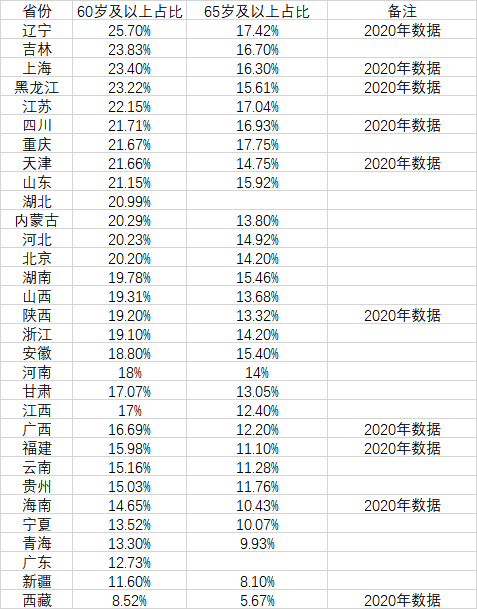
Data source: First Financial Reporter organizes the sorting of statistical communiqués in various places, seven -person data, and public information
13 provinces accounted for more than 20% of the elderly
Among them, the proportion of three provinces exceeded 20%for the first time. On September 2nd, at the China International Services Trade Fair "2022 Smart Kangyang Summit Forum", the Beijing Aging Office and the Municipal Aging Association released the "Beijing Aging Career Development Report (2021)". The report shows that in 2021, Beijing's population aging is further deepened, and the permanent population of 60 and above will exceed 20%for the first time. According to international standards, when the proportion of population between 60 and over, the proportion of population is 20%-30%, or the proportion of population in the age of 65 and above is 14%-20%, which means that the region enters a moderate aging society.
Outside of Beijing, in 2020, the 60th and above population accounted for the first time in the provinces, which exceeded 20%of the provinces for the first time in Hebei and Inner Mongolia. According to data from the Inner Mongolia Statistics Bureau, in 2021, the population of Inner Mongolia is 4.87 million years old and over, accounting for 20.29%, of which 3.32 million people are 65 and over, accounting for 13.83%. The proportion of population 60 and above and 65 and above increased by 0.51 and 0.78 percentage points, respectively. The proportion of population 65 and above in the region is lower than the national average of 0.37 percentage points, while the proportion of population 60 and above is higher than 1.36 percentage points across the country. The large population base between the ages of 60-64 means that in the next 5 years, the population of 65 and above the region will continue to increase.
Hebei was 60 and above in 2021. The elderly population was 15.07 million, accounting for 20.23%of the total population, an increase of 0.38 percentage points from the previous year, of which 11.11 million were 65 years old and over, accounting for 14.92%of the total population, rising increased, rising 1.00 percentage points.
From the perspective of regional distribution, the provinces with a population of more than 20%of the elderly are mainly distributed in the northeast, North China, the Yangtze River Delta, Sichuan and Chongqing in the southwest, and Hubei in the central and central parts of East China. Generally speaking, the urban and industrialization of some provinces started earlier, with a low birth rate, and a large number of young people flowed to the developed areas of the southeast coast, so the elderly population accounted for a relatively high population.
Jilin University's Northeast Asian Research Institute professor Yi Baozhong analyzed the First Financial Analysis of the First Financial and Economics. Due to the economic downturn and the lack of industrial development, employment opportunities have decreased. In recent years, the population of the Northeast has continued to flow out. The fertility rate is low, so the aging population accounts for relatively high.
In Baozhong said that the industrialization and urbanization of the Northeast are earlier. Enterprises are dominated by state -owned enterprises. Many employees are in state -owned enterprises and administrative institutions. The planning of family planning is strict, and the proportion of only children occupies is particularly large. Coupled with the flow of some young people, the proportion of young people's employment population is even lower.
Hubei, Chongqing, Sichuan, and Hebei in North China in the central and western regions, due to the inflow of a large number of young people in developed provinces, the aging level of these provinces is also relatively high.
And there are many developed regions such as Shanghai, Jiangsu, Beijing, and Tianjin, and there are a large number of young people flowing in. Why is the proportion of elderly population a higher proportion? This is because on the one hand, these localities are industrialized and urbanization earlier, and the population birth rate is relatively low. If the proportion of adolescents is low, the corresponding elderly population will have a higher proportion. On the other hand, these local local medical care and living conditions are good, and the per capita life expectancy is higher, so the proportion of elderly population will be relatively large.
The number of elderly people in Shandong, the fifth of Guangdong
Judging from the number of elderly population, Shandong is the only province with a population of over 20 million. On July 26, the 36th meeting of the Standing Committee of the 13th National People's Congress of Shandong Province heard the report of the provincial government on the protection of the rights and interests of the elderly in the province.
The report shows that Shandong Province is the first elderly population province in the country. As of the end of 2021, the elderly population of 60 and above in the province reached 21.51 million, accounting for 21.15%; the 65 -year -old population was 16.1938 million, accounting for 15.92%; The proportion of 60 -year -old and 65 -year -olds is higher than 2.25 and 1.72 percentage points across the country, respectively, showing the characteristics of large bases, rapid growth, and high degree of level.
In contrast, although the total number of resident population in Guangdong, the first economic province is far ahead, the 60 -year -old population is only 16.15 million, not only far less than Shandong, but also lower than Jiangsu, Sichuan and Henan. The quantity ranks fifth in the country. Guangdong's elderly population accounts for only 12.73%, which is far below the national average of 18.9%. The proportion of the elderly population in Guangdong is low, and a major reason is that there are a large number of young people flowing in. Seven -person data shows that the population flow in Guangdong Province reached 29.622 million, which was more than 13 million more than Zhejiang in the second place. The population flow is mainly based on young people. At the same time, the population flow of inter -provincial flow is calculated in accordance with the concept of hukou. In fact, due to the relatively loose settlement threshold of Guangdong, there are also a large number of net registered people from outside the province. For example, there are a large number of university graduates in both lakes and southwest region settled in Guangdong. From 2010 to 2020, the population of foreign household registration in Guangdong Province reached 3.12 million.
Another reason is the birth rate of the higher population in Guangdong. Although the urbanization rate of Guangdong has reached 74.63%, after the three municipalities of Shanghai, Beijing -Tianjin, ranked fourth in the country, Guangdong is a rare birth rate in provinces with high urbanization and urbanization rates. In 2021, the birth rate of Guangdong's population was 9.35 ‰, which was far higher than the national average of 7.52 ‰.
Peng Peng analyzed the first financial and economic analysis of the executive chairman of the Guangdong Provincial Sinical Reform Research Association. Like Chaoshan, Zhanjiang and other places in the east of Guangdong, the attractive foreign population is relatively small, and the population growth is mainly growth. It is also declining, but due to the traditional fertility culture, compared with other regions, the willingness to fertility in these places is still relatively high.
In addition, the population flowing into Guangdong is mainly young people, and these people are also the main force of fertility. Therefore, the birth rate of the Pearl River Delta region is relatively high. Due to the high birth rate and a large proportion of young people, the proportion of elderly population will also be lower.
- END -
The bank encountered "serial fraud loan" and lost a total of 800 million yuan!

After fabricating the audit report, the benefits of more than 100,000 yuan were ch...
Policy dividends will be further released in the industry. The industry is expected to continue the
Financial data in May exceeds market expectations. However, under the data of new credit and social recovery, there is also a slightly sluggish corner -the medium- and long -term loans in the reside