Which industries under the age of 35 are the most concentrated?Which provinces account for low proportion of young employment population?Interpretation of the age structure of China's employment population →
Author:First financial Time:2022.09.01
01.09.2022

Number of this text: 2238, the reading time is about 4 minutes older
Introduction: Among my country's employment population, the proportion of under 40 years of age accounts for 45.3%, of which 7 provinces have more than 50%, and Tibet, Guangdong, Shanghai, Beijing, and Tianjin rank among the top five.
Author | First Finance Lin Xiaozhao
China's aging is accelerating. What is the age structure of my country's employment population?
The National Statistics Bureau recently announced the "Chinese Population Census Yearbook -2020" detailed disclosure of the seventh population census sub-item data. Among them, in the fourth volume of long table data, there are the age distribution of the employment population in the country and provinces. According to this, the first financial reporter calculated that among my country's employment population, the proportion of under 40 years of age accounted for 45.3%, of which more than 50%of the provinces, Tibet, Guangdong, Shanghai, Beijing, Tianjin ranked among the top five.
According to the yearbook description, the seventh national census uses two census tables: long and short census. The census short table includes projects that reflect the basic status of the population, which are filled by all residents (excluding Hong Kong, Macao and Taiwan residents and foreign personnel); census leaders include projects of all short meters projects and population, marriage, and housing. 10%of the residents (excluding Hong Kong, Macao and Taiwan residents and foreign personnel) are filled in among all residents. Because the census table is sampled by households and registered, the total population and the sampling ratio of various population structure data will be slightly different.
Where are the high proportion of young employment population?
According to the census data, among my country's employment population, the proportion of under 30 years of age is 17.7%, the ages of 30 to 39 account for 27.6%, the ages of 40 to 49 account for 25.1%, and 50 ~ 59 years old account for 20.8 to 20.8. %, 8.8%over 60 years old.
From the perspective of all ages, the proportion of 30 to 39 years is the highest, and the proportion of 40 to 49 is the second highest. The total proportion of the two reaches 52.7%. "". On the one hand, compared to the "post -90s" and "post -00s", "post -70s" and "post -80s" have a large number of births; on the other hand, in the 2020 census, a large part of the "post -90s" have not yet left the campus. Therefore, the proportion of the employment population under the age of 30 is also relatively low.
Since 1962, my country has ushered in a wave of birth population for more than ten years. As some "post -60s" women have retired, and some people retreat in advance, the proportion of employment population in the "post -60s" is also lower than the "post -70s" and "post -80s".
If the division is divided into 40 years old, among my country's employment population, the proportion of under 40 years of age accounts for 45.3%; in terms of provinces, 7 provinces account for more than 50%, namely Tibet, Guangdong, Shanghai, Tianjin, Tianjin,,,,,,, Tianjin, Tianjin,,,,, Xinjiang, Qinghai.
The "35 -year -old phenomenon" is the focus of workplace attention in recent years. If the division is based on the 35th age, the employment population in my country accounts for 32.9%of the age of 35. In terms of provinces, there are more than 40%of the provinces, which are Tibet, Guangdong, Shanghai and Beijing.
On the whole, there are two main parts of the provinces with high proportion of young people in the employment population: First, Tibet and other western provinces. These places are affected by factors such as natural geographical conditions and living habits. At the same time, these local tourism industry and other industries have developed well, and they have also attracted many young people.
The other part is the developed coastal economies of Guangdong, Shanghai, and Beijing. Niu Fengrui, a researcher at the Center for Urban Development and Environmental Research of the Chinese Academy of Social Sciences, analyzed the first financial and economic analysis. These places flowed into the population with a large population, and young people were the main body.

From the perspective of industrial structure, information transmission, software and information technology services, culture, sports and entertainment, scientific research and technical service industries, and the financial industry, the top three industries, rank among the top four. Specifically, information transmission, software and information technology service industries account for the highest employment population under the age of 35, reaching 64.6%. Among them, the proportion of the Internet and related services of the industry accounts for 70.4%. The proportion of culture, sports and entertainment industry is 51.5%, the proportion of scientific research and technical service industries is 50.2%, and the financial industry accounts for 49.2%.
In my country's second largest industrial manufacturing industry, some segmented industries such as computers, communications and other electronic equipment manufacturing, electrical machinery and equipment manufacturing, automobile manufacturing, and pharmaceutical manufacturing are 35 years old. The following proportion is also relatively high, and these manufacturing industries are more concentrated in economic developed areas such as Beijing, Shanghai, and Guangdong.
The proportion of young employment in these provinces
In contrast, the provinces with relatively low young employment population are mainly concentrated in the northeast, Shandong, Sichuan, Anhui and other places. For example, from the perspective of the proportion of employment population under the age of 40, there are only three provinces that are less than 40%. They are three northeast provinces, Jilin is 37.4%, Heilongjiang is 37.9%, and Liaoning is 39.3%. In addition, Shandong and Sichuan account for 40%to 41%.
Judging from the proportion of employment population under the age of 35, 6 provinces account for less than 30%, namely Heilongjiang, Jilin, Liaoning, Shandong, Guangxi and Inner Mongolia. Among them, Heilongjiang accounts for 25.1%, Jilin is 25.8%, and Liaoning is 26.7%.
Jilin University's Northeast Asian Research Institute, Ya Baozhong analyzed First Financial, the young employment population in the Northeast accounted for relatively low, which was related to industrial and economic structure. The industrial structure in the northeast is mainly based on the industrial structure of heavy industries and assets. The heavy industry has high dependence on machinery, and it is not as much as light industry as light industry. In terms of economic structure, the development of the private economy in the Northeast region is relatively weak, and the ability to absorb employment is also worse. Many young people flow out. In the field of clothing, the northeast is mainly based on the state -owned economy. The previous family planning policy was strictly implemented, and the only child in the Northeast was particularly large. A considerable part of the employment population under the age of 40 is the only child. Coupled with the flow of some young people, the proportion of young people's employment population is even lower.
For many provinces, there are two major factors in the low proportion of young people in the employment population: First, a large number of young laborers flow to the developed areas of the east coast. Taking Guangxi as an example, seven -person data shows that there are as many as 6.930 million Guangxi people flowing into Guangdong. On the whole, the Huanghuaihai Plain, the middle reaches of the Yangtze River, and the southwestern region are the largest regions of my country's population. The outflow of young labor, the proportion of young employment in the local area has also declined. Second, provinces with a large agricultural output value and a high proportion of agricultural production population, the employment population of middle -aged and elderly people accounts for relatively high.
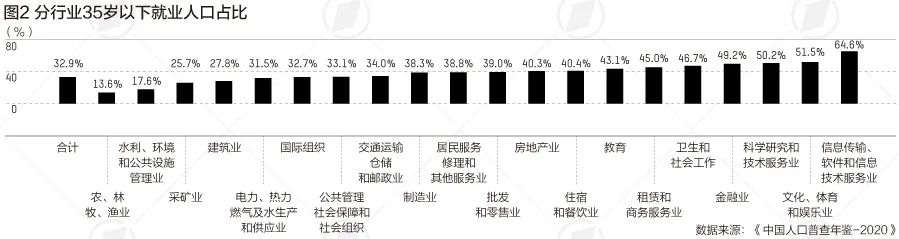
Data show that the proportion of employees in agriculture, forests, pastoral, and fisheries accounted for 20.6%of the employment population. Among the employees of agriculture, forests, animal husbandry, and fisheries, the proportion of under 35 years old was only 13.6%, which is the lowest proportion. industry.
Among my country's employment population, 8.8%of those over 60 years old. The elderly employment population is mainly in rural areas, mainly engaged in the agricultural, forestry, animal husbandry and fishery industry, and secondly, there are some elderly employment population in the catering and other industries. In terms of provinces, the provinces with relatively high employment population over 60 are Shandong, Henan, Sichuan, Hebei, Anhui, and Jilin. The agricultural development of these places has a high output value, and the proportion of agricultural production is relatively high.
- END -
Meihulin presided over the third quarter economic operation dispatch meeting in Maqu County

On September 1st, Mei Hulin, member of the Standing Committee of the County Party ...
[Follow] Informatization management
Xiaobo, Xiaobo, open the fifth sequence. It is opening the fifth sequence, please pay attention to safety! On July 4th, in the archives room of Yanji Talent Service Center, the head of the personn