The alarm sounds from Gongga Mountain: Building a building in the building?
Author:First financial Time:2022.09.07
07.09.2022

Number of this text: 3282, the reading time is about 6 minutes older
Guide: After the Haicheng and Tangshan earthquakes in 1978, the relevant domestic architectural specifications required that "small shocks are not bad, medium earthquake can be repaired, and big earthquakes do not fall."
Author | First Financial Wu Siyi
A three -storey white building was short of a short layer like being cut off. Only the entrance hall still stubbornly tilted his neck and stood up.
This is a widely spread photo of the Luding earthquake disaster. The building in the photo is the observation test station of the Gongga Mountain Ecosystem of the Gongga Mountain Institute of the Chinese Academy of Sciences (hereinafter referred to as "Gongga Mountain Station"). Like many weak houses in the earthquake area, the house of the large state -owned unit of Gongga Mountain Station failed to survive the sudden disaster.
At 12:52 on September 5th, a magnitude 6.8 earthquake occurred in Luding County, Ganzi Prefecture, Sichuan (29.59 degrees north latitude, 102.08 degrees east longitude), and the depth of the earthquake was 16 kilometers. As of 21:00 on the 6th, the earthquake has killed a total of 74 people in Ganzi and Ya'an in Sichuan. The Gongga Mountain Station is located in the highest peak of Hengduan Mountain. Instead of Hailuogou, Gongga, it is about 50km from Luding County. Among the victims, it included a master's degree in scientific research at the station at the time.
However, many experts in the fields of construction engineering and planning are not agreed to now determine that the building's shock resistance is not up to standard. The Gongga Mountain Station was built in the 1960s and 1980s. At that time, the earthquake resistance standards were different from the present. Whether the construction of the building is severely damaged by the quality is to investigate the relevant departments.
But the disaster bring the public's doubts about the performance of architectural defense and seismic resistance is real and valuable -Is the earthquake resistance of public buildings sufficient? Why do the multi -story buildings in the affected mountain area have frequently collapsed at the bottom? Is the city's high -rise buildings safe? What buildings need to be repaired and demolished?
Gongga Mountain Station is near the seismic design warranty period
According to information on the official website of Chengdu Mountain Institute, Gongga Mountain Station was built in 1987. However, as for when the building of the test station is planned and designed, there is no relevant information on the official website. On the 6th to 7th, the First Financial Reporter called Chengdu Mountains many times, but as of press time, it has not been dialed.
According to the relevant reports of Guangming Daily in 2017, as early as the 1960s, scientists from the Chinese Academy of Sciences carried out scientific research in this area.
In the "Specifications for Earthquake Design" (Draft for the Solicitation of Local Amendments) released by the Ministry of Housing and Construction at the end of last year, it was mentioned that the design and use of the structural design is to consider the normal use after the construction is completed. The warranty period of predetermined functions is taken for 50 years at home and abroad.
For the Gongga Mountain Station, which has been in public purposes such as the construction of the building for at least 44 years, is in the area of earthquakes and is used in public purposes such as teaching, scientific research, etc., Professor Zhao Bin, School of Civil Engineering, Tongji University believes that "the structure collapse of the structure indicates that the existing earthquake -like regions are existing areas. Architecture, there is a need to perform shock resistance and reinforcement. "
He told reporters that after the Wenchuan earthquake, especially in recent years, the Ministry of Housing and Urban -Rural Development has repeatedly emphasized the construction of public buildings with a long period of use, low seismic standards, no anti -seismic prevention measures, or failing to meet the current anti -mandatory standards for earthquakes. In the case of seismic performance, reinforcement, and maintenance, some important provinces and cities also carried out too many census work on schools and houses. At the actual level of operation, most of the current situations are still targeted and reinforced on which existing buildings with structure or functional changes.
"However, because the relevant work is not hardly required, and the cost of renovation requires the construction of the owner of the building, the relevant subject units may not be motivated." Zhao Bin added.
So, in the context of no reinforcement maintenance after completion, how far the public building built in the 1980s or before is compared with today, and the seismic performance is far apart?
Structural engineer Xu Ke told reporters that there are two cases. Prior to the Tangshan earthquake in 1978, the Chinese architectural earthquake resistance standards mainly borrowed the Soviet "Earthquake Area Building Specifications". During this period, the earthquake resistance capacity was relatively poor. After the 1978 Haicheng and Tangshan earthquakes, my country published " The Specifications for Industrial and Civil Building Seismic Anti -Design "and" Specifications for Earthquake Design of Buildings ", which have since complied with the specifications for design and construction, can meet the requirements of" small earthquakes are not bad, medium earthquake can be repaired, and large earthquakes will not fall. "
From a structure, Xu Ke believes that the buildings of the Gongga Mountain Station may belong to the frame structure, that is, the structure of the formation of the beam and column combination as the vertical load -bearing and anti -horizontal effect. Due to the large space at the bottom of such structures, and more buildings above the bottom, more building vertical and horizontal walls are used, which are common in public buildings such as hospitals and conference halls.
"The frame structure itself is a commonly used and reliable structure. But when the reasons for the distribution of the building wall, there is a situation where the bottom rigidity is small and the upper rigidity is large, or the actual carrying capacity of the underlying component is lower than the design goal, or at the bottom at the bottom When the loading capacity of the column component is weakened and the actual demand decreases significantly, the earthquake resistance performance of the building does not meet the safety goals under the limit. "Xu Ke said.
Zou Liang, director of the Academic Committee of Urban Safety and Disaster Prevention Planning of the Chinese Urban Planning Society, Zou Liang, director of the Urban Safety Research Center and professor of the Planning and Design Company of the Planning and Design Company of the Planning and Design Company of the Planning and Design Company of the Planning and Design Company of the Planning and Design Company, further introduced to the reporter that in the frame structure, the underlying structure is the largest. For a single component, the most stressed place is the contact node of the pillar and the ground and the beam. Therefore, when the earthquake occurs, the node area is most likely to be destroyed. Under the action of seismic waves, the deformation of the underlying framework is often a weak floor of the entire building structure, which causes over -large sides to collapse. However, compared to the brick -concrete structure, Zou Liang said that the seismic performance of the frame structure is still slightly better. If the brick -concrete structure does not adopt earthquakes such as constructor columns and ring beams, crushing collapse may occur when an earthquake occurs. "But this structure exists more in the building before 2000."
Because in previous earthquakes, the building of brick -concrete structures often collapses. Xu Ke suggested that the owner of the building can adopt traditional methods such as earthquake resistance on the basis of measuring economic costs. means.
According to the "Earthquake Management Regulations", which was officially implemented on September 1 last year, the owner of the construction project shall conduct safety monitoring of construction projects with serious seismic safety hazards, and take measures such as stopping or restrictions before reinforcement.
It specifically stipulates that new schools, kindergartens, hospitals, elderly care institutions, children's welfare institutions, emergency command centers, emergency asylum places, radio and television and other buildings such as high -level defense areas and earthquakes. Earthquake reduction and other technologies can ensure that the normal use requirements can be met when the earthquake is set up in this area.
Multi -layer or higher -level is safer?
Compared with public buildings, in this earthquake, the damage to private houses and homestays is more serious.
Four Elephant Technology told the First Financial on the evening of the 6th that from the perspective of the remote sensing satellite monitoring image map, as of 12 noon on the 6th, some areas of Luding County, roads and bridges were not damaged, and Ganzi Prefecture Vocational and Technical School, including, The appearance is intact and no damage.
Picture source: Four Elephant Technology
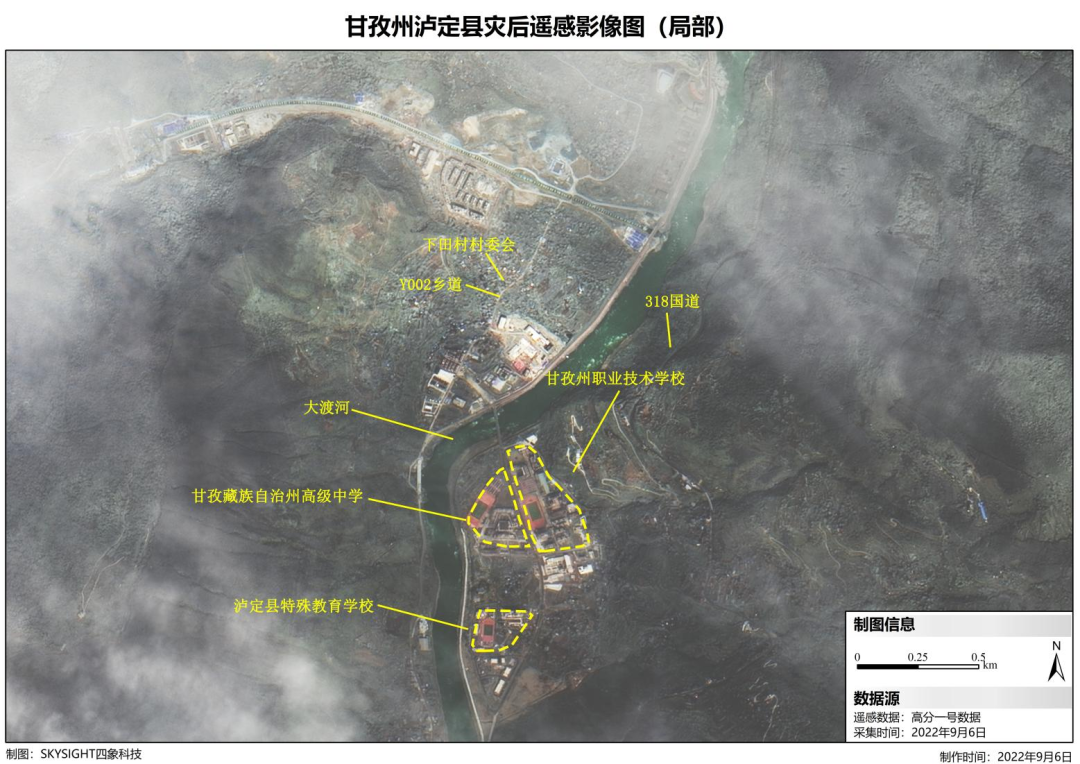
According to the Ganzi State Party Committee Office, as of 7:00 on September 6, after preliminary verification, the 6.8 magnitude earthquake in the "September 5th" of Luding County involved Luding, Kangding, Kowloon, Yajiang, and Danba (city cities (cities (cities (cities (cities (cities (cities To. It has been initially investigated 243 and 13010 damaged; 4 collapses and 307 damaged buildings in hotels, hotels, homestays, etc.
Some residents living in Luding County told First Finance that most of the houses in Moxi Town are mixed bricks and brick and wood structures. The height is generally two or three floors, six or seven floors.
Zhao Bin said that there is a considerable percentage of houses in towns and rural areas to build a house for residents. After the Wenchuan earthquake, the state's earthquake -resistant management of self -built houses became stricter. The local government also gave demonstration of demonstration drawings and programs for newly built self -built houses according to the characteristics of the region. However, for the built -up houses that have been built, because the state cannot force residents to transform at their own expense, after the earthquake, this part of the house will still be vulnerable.
"Newly built self -built houses in the area of earthquake resistance are different, and are also avoided in areas where the seismic bands and secondary disasters such as landslides are also prone to occur in the site. For seismic factors, the builders are mostly folk craftsmen. Whether there are architectural drawings, whether the building materials meet the requirements, whether there are cutting corners or irregularities in the construction process, it is often difficult to control the owner of the self -built house. "
Another factors to increase losses in private houses are that secondary geological disasters such as landslides occur after the earthquake. "If the foundation is destroyed or buried by the flying stone collapsed by the mountain, this will be an irresistible factor for the private house. The damage of the private house has nothing to do with whether it has shock resistance." Xu Ke said.
Zou Liang, who has participated in the special planning of comprehensive disaster prevention and mitigation in many cities across the country, said that private houses with better earthquake resistance and no damage to the building subject need to be reinforced after disaster. This should be judged by professionals.
"After the previous earthquake disaster, relevant departments such as the Ministry of Housing and Construction will organize a number of expert groups to evaluate the buildings in the disaster area. For the occurrence of objective destruction such as cracks, cracks or epidermis falling in the wall, it should be further evaluated whether it will affect it will affect it. Structural is safe. If it is not, then it can be restored to use simple repair; if structural component damage occurs, it may need to be reinforced or even reconstructed. "Zou Liang said.
The earthquake also had an impact on Chengdu, and there were online videos and rumors such as "deformation" of high -rise housing "building deformation" and "broken beams in the building". In response, the relevant department of Chengdu responded through the official Weibo that after the preliminary investigation of professional professionals, the roof deformation sewing of the Internet building was complete, and there were no hidden dangers of structural safety.
Zhao Bin told reporters that the buildings that strictly follow the standards of seismic design generally have good seismic resistance and meet the "big earthquakes". Compared with low and multi -storey buildings, many long -term research in the industry show that the earthquake resistance capacity of high -rise buildings is relatively better.
"But it should be noted that if the building is close to the seismic fault and a broken zone, the earthquake resistance capacity of high -rise buildings may not be as low as low and multi -layered buildings. During the earthquake, the large displacement and long cycle vibration components caused by the faults are relative to the self -vibration cyclical relative relative period of relative vibration cycle. The longer high -rise buildings are particularly unfavorable. "Zhao Bin said.
- END -
The Civil Aviation Administration of Air Manage

On July 14, the Civil Aviation Administration Air Management Bureau organized the ...
Yuhang's retired soldiers successfully donated hematopoietic stem cells in 1999

Yesterday, Shen Jialei, a donor of hematopoietic stem cells, completed the collect...