Saiwai Northern Xinjiang Ecological Concerto -Inner Mongolia
Author:Xinhua News Agency Time:2022.09.13
The autumn harvest is approaching. Zheng Jie, a villager in Ma'anshan Village, Chifeng City, Inner Mongolia, is scorching on the top of his head and poured water on the 2 acres of vineyards on the hillside. In a few days, he will collect grapes. This year, he can earn about 6,000 yuan by grapes.
In addition to planting land, 59 -year -old Zheng Jie also has an important job -a forest guard, responsible for patrolling 500 acres of forest land in the village.
The forest coverage rate of Ma'anshan Village reaches 90%, which is a microcosm of the integrated governance of landscapes, forests, lakes and sands in Inner Mongolia, and builds the Great Wall of Green Wall for thousands of miles. Inner Mongolia, which has a variety of natural forms such as forests, grasslands, wetlands, rivers, lakes, and deserts, is becoming a beautiful landscape in northern China.

This is Wu Liang Suhai (drone photo) taken on October 27, 2020. Xinhua News Agency reporter Lian Zhen was photographed
"Protect the grassland, life can be better"
Korqin's right front flag Taohe Mu Mu, hills, rivers and lakes. Lange grassland is "painted" neatly on the small square to form a unique scenery.
"The small square grid is a reed sand barrier, and the grass inside is artificially sowing the grass species." Said Bu Renseyin, director of Taohemu Sumu Comprehensive Administrative Law Enforcement Bureau, said that the place where the sand was severe before is now dense. Small grass.
In May of last year, Taohe Mu Mu launched the grassland ecological restoration project, invested 9 million yuan, and adopted a comprehensive measure of natural breeding recovery and supplemented by manual intervention restoration as a supplemented by reimbursement of manual intervention.
Monitoring data shows that from 2016 to 2021, the capacity of the grassland plantation of Keqianqianqi increased by 28.67 percentage points. The water quality of the river in the flag domain reaches the III standard.

This is the August 16, 2022 in the Korqin Sand Forestry Claim (UAV photo) taken in the left -wing back flag of Corqin City in Tongliao City. Xinhua News Agency (Photo by Huawei Guang)
In the Gongyouqian Ban Ban Mao Dadu Grassland, from time to time, a group of cattle and sheep can be seen. Here, the grassland is approved according to the standard of 16 acres of sheep and a cow of 80 acres of cows. The herdsmen receive a grassy animal balance subsidy of nearly 4 yuan per acre.
The Mongolian herdsman Sa Ren Gaowa has more than 10,000 acres of grass fields, rented 10,000 acres, and 200 acres of land to return farm and return grass. She raised more than 100 cows and nearly 700 sheep, and the number was half reduced compared to the past. "Our ancestors live here, protect the grassland, and life can be better." She said.
Sa Ren Gaowa hired two sheep's pupa and used his energy for dairy cooperatives. Next to her house, a 330 -square -meter dairy product production workshop has just been operated for more than a month.
"We produce milk tofu, yogurt, cheese, etc., driving herders to increase their income," Sa Ren Gaowa said.
Korqin's right -wing Zhongqi Kazaka Qichaqicha. In the past, the land deserted and saline was serious.
The herdsman Bai Jilin Bai Yila told reporters: "Once in the past spring, sandstorms often scraped for several days, and sand under the door and window sills."
Bai Jilin Bai Yila was a poor household. In 2017, benefiting from the poverty alleviation and relocation policy, he moved into the government's 80 square meter brick house, and he was also equipped with a cow shed. This year, the local babies were completely banned, and his cattle began to raise.
A few years ago, the 1,500 acres of sea buckthorn forests planted by Gacha Shahe has grown to more than 1 meter high. The 56 -year -old Bai Jilin Baiyra is a forest guard who often preach ecological protection to people in the villagers. In recent days, he and 4 people in the village harvested silage corn to prepare grass for livestock. His wife Liu Menglan was a Mongolian traditional embroidery at home when she was leisure. The beautiful grassland was her commonly used pattern.
The secretary of the Gacha party branch, Jin Zaraga, calculated the account for reporters: the whole village raised more than 2,800 cows, and the cost of raising cattle after breeding was higher, but the improved beef cattle varieties were about 2,000 yuan per head than before; the sea buckthorn forest Ecological benefits have appeared, and economic income will be seen in the next year. According to the calculation of 100 kilograms of sea buckthorn fruit, 1500 acres can produce about 150,000 kg, and it can sell for 145 yuan per kilogram. This income is considerable, and the collective economy will grow.

This is the shepherd group (drone photo) on the Wulan Maodu grassland taken on June 23, 2022. Xinhua News Agency reporter Liu Lei Liu Lei
At present, the effective recovery ratio of the sandy land of Keyouzhong Banner is more than 90%, and the comprehensive vegetation cover of the grassland has increased from 35.17%in 2017 to 70%.
Data show that in the past 10 years, Inner Mongolia has accumulated a total of 122 million acres of afforestation and 286 million acres of grass, and an average annual anti -sand control of more than 12 million acres. The area of desertification and desertification land has continued to decrease.
"The farmland is my own, and the environment is everyone."
The morning light sprinkled on the calm Wuliang Suhai Lake, and the birds were crisp.
On the shore of the lake, Liu Xiuzhen, who was in the Gaica Lake in Urad, accompanied the rhythm of music with several old sisters to stretch his body cheerfully.
"We often come to morning exercises or walks when we are leisure, and the air is good here." Liu Xiuzhen, 51, said. The window of her house was clear, the furniture was new, and the window sill was covered with flowers and green plants.
"In recent years, Wu Liang Suhai's environment has improved, and we have decorated the house. The surrounding environment in the past few years is too bad, and we want to move away." Liu Xiuzhen said that the lake was brown in the past and the taste was unpleasant. Now the water is clear. There are more fish, and there are more birds. Hongyan, who has never seen it, came to the lake last year to pass the winter.

Swan played on the water surface of Wu Liang Su Sea (taken on October 28, 2020). Xinhua News Agency reporter Lian Zhen was photographed
Wuliang Suhai, located in the Yellow River River Case irrigation area, covers an area of 293 square kilometers. Since the 1990s, the pollution in the lake area has continued to intensify, and large -scale yellow algae. Long -term farmland excess fertilization is one of the main reasons. Since 2018, local rewards and incentives, agricultural technology promotion and other means, comprehensively carry out fertilizer, drug control, water control, and membranes, to guide farmers and enterprises to produce green production, and reduce agricultural pollution.
"The farmland is ourselves, but the environment is everyone. We must protect our land." Liu Xiuzhen's 80 acres of land was changed by corn to plant wheat, using farmhouse fertilizer, artificially pulled grass, and did not cover the membrane.
Her wheat in her family has applied for a non -risk -free product, and the price is higher than that of ordinary wheat. Coupled with government subsidies, it can increase the income of 40,000 yuan a year.
At the foot of the Helan Mountain in the Alxa League, the grass and trees were lush, and occasionally a few strong rock sheep ran across. The locals said that there are still rare animal snow leopards recently.
Helan Mountain has been mining coal since the 1950s and 1960s. Due to the backward production method and the lack of environmental protection awareness, the ecological environment has been destroyed to a certain extent. Coupled with excessive logging and overloaded grazing, the degradation of the vegetation of the forest and grass, and the soil loss is serious.
Since 2016, Alashan League has strongly carried out environmental improvement operations in Helan Mountain Reserve and surrounding surroundings. During 3 years, 57 coal washing factories were demolished, 67 coal mines were permanently closed. The residue governance was 11.5 million square meters.
Summer scenery (drone photo), the National Nature Reserve of Helan Mountain in Inner Mongolia on July 11, 2022. Xinhua News Agency reporter Behch Photo

"Now Helan Mountain has good ecological protection. Compared with 20 years ago, the edge of the forest is advancing 5 meters to 10 meters." Said Li Dong, deputy head of the Harawu Workstation of the Helan Mountain National Nature Reserve of Inner Mongolia.
Data show that in 2021, the proportion of excellent air in Inner Mongolia increased by 3.7 percentage points compared with 2015; the proportion of excellent water bodies in the national surface water assessment section was 22.9 percentage points compared with 2016.
Dark Mountain becomes a "Jinshan" sand pit to become "treasure pot"
Ma'anshan Village, Chifeng, is named after a mountain -shaped mountain. The archway near the village entrance, on both sides of the clean and flat road is a long and long sea of flowers. The brick housing in the village was staggered, and the green trees were covered. On a hillside, the facility of the tourist reception center is under construction.
More than 10 years ago, it was not what it is now. Due to the reclamation of mountain forests and excessive grazing, "the mountains are bare, the flood is emitted when the rain is rained, and the stones have rushed down." Said Zhang Guozhi, the secretary of the former party branch of the original village.
"We have set the policy of‘ who does not affect others, who has to plant and who has, to mobilize everyone's enthusiasm and encourage tree planting. "Zhang Guozhi said.
This is the Ma'anshan Village (drone), Karaqinqi, Chilang City, Inner Mongolia, which was taken on July 15, 2019. Xinhua News Agency reporter Liu Lei Liu Lei

Ma'anshan Village has returned farmland to forests and greening 3,000 acres. The mountains are green, and mountain goods such as hazelnuts, mushrooms, and mountain apricots bring income to the villagers. Du Zhongwei, a young man who sold the goods, said that he made 10,000 yuan last year.
Mountain grapes and tourism have become village -leading industries. 3,500 acres of mountain grape planting in the village, two wineries were built. In 2017, Ma'anshan Village took off the hat of poor villages. Last year, the per capita disposable income of the village reached 15,900 yuan.
In recent years, the living environment of Maanshan Village has improved significantly. The whole village has transformed 190 people's toilets and has also established a classification trash can. Villagers have enhanced environmental awareness.
"We will continue to increase green and build a 5A -level scenic spot." Liu Yeyang, secretary of the village party branch, said.
With the comprehensive advancement of the construction of ecological civilization, the Inner Mongolia agricultural and pastoral areas actively explore a variety of forms of agricultural tourism integration and green development. From the urban area of Ulanhot for more than 10 minutes, it was Gaogen Yingzi Gacha. After a piece of rice fields, the lively water park came into view. Adults take their children to play on the beach and shallow water. Nearby is a "Rural Revitalization" train restaurant.
The cadre of Gacha introduced that this section was the old river of the Laer River, and later became a waste sand pit and a garbage dump. Since 2019, the government has used assistance funds to perform ecological restoration and governance of the old river channels, build a Shenjun Bay ecological experience area, and absorb 35 villagers' employment. The operator is distributed to the village collective 450,000 yuan each year, and the village collective dividends are divided into the village.
"The beach is very suitable for children to play. The lake is also very beautiful." Qiu Yi, 18, told reporters after taking a cruise in the scenic area with her sister. They and relatives have a total of 12 people from the urban area.
Peng Dianqi, a Gaogen Yingzi farmer patrolling in the scenic area, wore a sun hat and a security service, optimistic and capable. He transferred the land to his son, and the house was leased to a pastry factory, and he and his wife lived in the young son's house in the city.
"A few years ago, it was stinky. Who thought of 'broken sand pit' now has become a 'cornucopia'?" Peng Dianqi, 60, said with a smile. He rides an electric motorcycle every day to work, with a monthly salary of 4,500 yuan.
"In the past, I couldn't eat it. Now I ca n’t say that I’ m so rich, and it has reached the life of a well -off life in my mind! ”He lamented that it was the party’ s good policy that made life changes.
The person in charge of the scenic area construction project introduced that in the future, it will also need to engage in ice and snow tourism to create a street and camping site, etc., which will absorb more villagers' employment and better realize and enhance the value of green mountains and green mountains.
"Still eating by the forest, but the way is different."
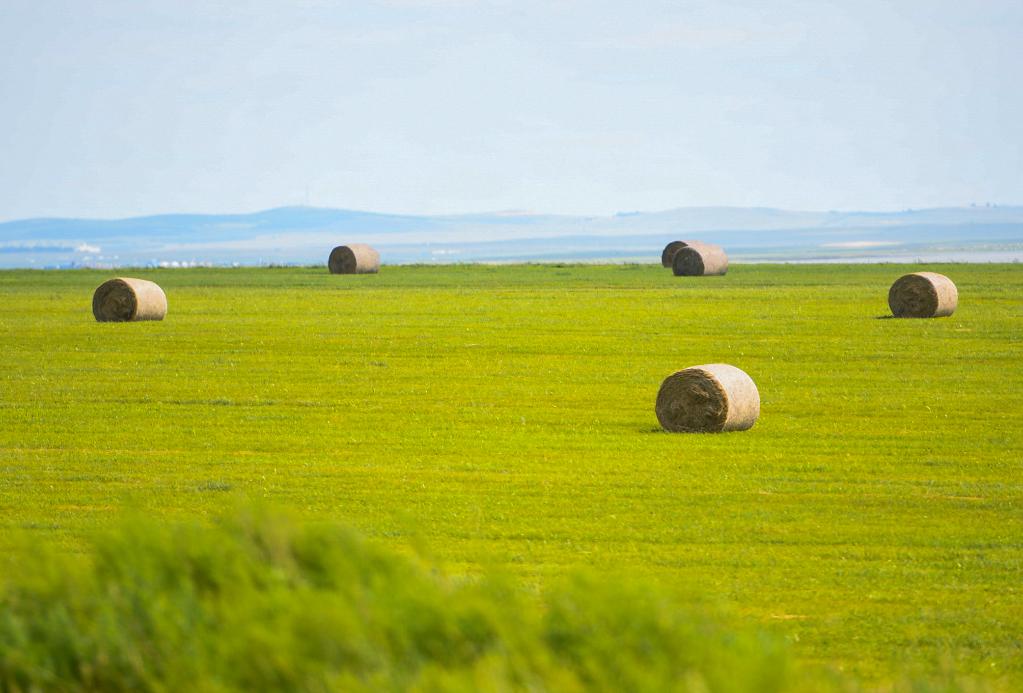
On the vast grassland of Hulunbuir, the horses and sheep a group ate grass leisurely. The machine's cylindrical straw bundles are lying on the grass in an orderly manner, waiting for the owner to transport it. This is a reserve made by herders for the wintering of livestock, and it is also sold elsewhere. The grass bundles were shot on the Hulunbuir grassland on July 25, 2022. Xinhua News Agency reporter Peng Yuan
Located in the Daxinganling Forest District, which is located in the Hulunbuirgen River, the colorful leaves spread, and now it is the season of "picking autumn". Matsushi, mushrooms, Matsutake and other mountain goods have become the source of local people's income. The workers at the North Bank Forest Farm at the Mori Mori Group of Inner Mongolia were busy planing the pits on the mountain to prepare for planting trees next spring.
"Ecological protection is our main business now." Said Zhou Yizhe, the 58 -year -old captain of the North Bank Forestry Workers. In the past, their main business was wood production. After the Daxinganling Forest Area stopped in 2015, he turned from cutting trees to seeing trees, responsible for forest fire prevention, cultivation, replenishment, and management.
In the Alishan City of Daxing'an Mountains in the southwest of Daxing'an, Zhou Changhe bid farewell to the "Banjie Mud" house in 2017 and lives in a new building. In the clean living room, there is a plaque on the wall. My wife Zhou Xiurong likes to dance with the sisters.
Zhou Changhe is 71 years old and is a retired forestry worker. He was responsible for repairing a small train that transported wood, and to this day, he clearly remembered the scene of removing small train lanes in forestry in the forest area.
"At that time, it was not a taste. I was worried that there was nothing to work. , Happy eyes.
Lao Zhou, who has been forestry for a lifetime, is very attentive to protect the forest. When he went to the mountains, he reminded people of the surrounding people to pay attention to fire prevention; seeing out of the wild vegetables, telling them not to put the roots out.
Today, tourism is the pillar industry of Alishan, and two -thirds of the local population are engaged in related service industries.
Lin Hai (drone) around the city of Alishan on July 24, 2022. Xinhua News Agency reporter Peng Yuan
Jiang Huixin is a manager of Alishan National Forest Park, responsible for the safety of tourists, vegetation protection and environmental hygiene. His father has been a oil sawman in the forest farm since 1987. "The sky is not bright, and my father is seeing the lubble with oil on his back. He returns very late at night, and it is very hard." Jiang Huixin said, "Later, there were fewer and fewer rare forests that can be collected. Come more. "

With the start of the natural forest protection project, his father turned from a logging worker to a forestant, planting trees and forestry, planting sea buckthorn. In the park, Jiang Huixin reminded tourists not to destroy trees and throw garbage. At home, he often educates a 5 -year -old son to respect and protect nature.
"I told him that flowers and trees have life, and they must take care of them." Jiang Huixin said.
"We still eat by the forest, but the way is different. There are beautiful forests and beautiful scenery, tourism has developed, and life is better." He said. (Participate in Writing: Yu Jia, Wang Jian, Ber Ri Khan)
(Wang Jinye Yin Yao Li Lai Fang)
- END -
Chinese Women's Football East Asian Cup big list: Wang Shuang led, did not recruit Shen Mengyu, and strive to win the first championship

On July 11, Beijing time, the Chinese Women's Football Team was announced in the E...
The big of the country, Mr. Da -Su Shi's circle of friends
In the three years of Song Renzong's calendar (1043), Su Shi (1037-1101) was eight years old and studied at the hometown of his hometown in Meishan. The scholars brought back to Shi Jie's Celebrate S...